AAG Provides Awards to Students from Community Colleges

Three students were selected to receive an AAG award for students from community colleges. Every year the AAG provides support for students from community colleges, junior colleges, city colleges, or similar two-year educational institutions.

Community college students who plan to transfer to a four-year institution to major in geography in the coming academic year applied for the 2016 Darrel Hess Community College Geography Scholarship. Eligible students must demonstrate scholastic excellence and academic promise. The scholarship provides students with $1,000 for educational expenses.

This year’s honorees include Eric Sheley of Front Range Community College in Colorado; and Leann Silvia of the College of Southern Nevada.

Eric Sheley decided to return to college after working 15 years in various jobs. His plan was to study History until he took a geography class. He said of his experience, “My mind was blown!” Today, Sheley is absolutely passionate about geography, has attended every geography class available at the college, scored top grades, and participated in all geography-related extra-curricular activities.

Eric will transfer to the University of Northern Colorado in the fall of 2016 where he will pursue a bachelor’s degree in geography. He will complete a geography internship over the summer. Sheley hopes to study more about food and agriculture, as well as different aspects of cultural geography. His contagious enthusiasm for geography, commitment to his studies, the quality of his work, and his contributions in the classroom and beyond, made him a standout candidate for faculty at Front Range Community College to nominate for this scholarship.

Leann Silvia, also a 2016 honoree, had a long list of possible college majors and wondered what she wanted to do with her life until she took a physical geography course at the College of Southern Nevada and completely fell in love with the subject. Silvia says, “I have yet to stumble upon another discipline area that excites, challenges, inspires, and fuels my curiosity as much as geography does, so effortlessly, on a daily basis.”

Leann will transfer to the University of Nevada, Reno in the Fall of 2016 to pursue a bachelor’s degree in geography. However, she has her sights set on a doctorate and a career where she can use her passion for nature to make a positive impact on the planet. Faculty at the College of Southern Nevada had no hesitation in nominating Leann for this scholarship; she is a natural student who will bring enthusiasm, positivity and creativity to her new university department.

Darrel Hess, coauthor of the textbook Physical Geography: A Landscape Appreciation, published by Prentice Hall, funds the Darrel Hess Community College Geography Scholarships. 

The AAG Community College Travel Grant provides financial support for outstanding students to attend the AAG Annual Meeting, covering conference registration fees and providing travel expenses, as well as complimentary membership in the AAG for one year. Darrel Hess and Robert and Bobbé Christopherson generously provide these travel funds.

This year the grant is awarded to Jennifer Lumpkin from Sinclair Community College in Dayton, Ohio, who has stood out among her classmates on geography and GIS courses. She has shown a particular talent for geospatial technologies, quickly mastering the more technical aspects of GIS, and applying her skills to projects in the local area.

On a mapping project in the Wright Dunbar neighborhood of Dayton, Lumpkin proved her leadership credentials as she forged a connection between community members and students working on the project, ensuring that local people were fully involved and ensuring that the project would have a real impact on the area.

Lumpkin also shone on a service-learning project that focused on the mapping and interpretation of visitors to sites along the Aviation Trail, a self-guided heritage tour in the Dayton area. She presented about this project at the annual meeting of the AAG East Lakes Regional Division at Kent State University in October 2015 and was awarded second place in the undergraduate paper competition.

Jennifer has a great enthusiasm for geography, particularly for all things related to mapping, and a determination to use mapping to make a difference in her local community. Attending the AAG Annual Meeting in San Francisco, where she will proudly represent Sinclair Community College, will enrich her geographical interests.

    Share

AAG Member and First Female Pakistani Geomorphologist Khalida Khan Honored as ISDR Researcher of the Year

Dr. Khalida M. Khan has been honored as ISDR Researcher of the Year at the U.S. National Postdoctoral Association (NPA) by the Inter-regional Directors’ Board of the SAARC-ASEAN Post-doc Academia.

Khan is an Associate Professor in Geology and Mountain Research at the University of Punjab. She also founded the Centre for Integrated Mountain Research (CIMR) at the Univeristy of Punjab in 1987 and has served as the Centre’s director since its inception. Dr. Khan is a former UNESCO chair holder whose research interests include geomorphology, sustainable development education, watershed conservation and management, socio-cultural and economic studies, women/gender and mountain studies, impact assessment of mountainous areas analytical studies, eco-tourism, hazard investigations, and strategic rural areas studies.

Learn more.

    Share

NCRGE to Discuss Funding Opportunities, Sponsor Sessions at AAG Annual Meeting

The National Center for Research in Geography Education (NCRGE) is sponsoring several sessions at the 2016 AAG Annual Meeting in San Francisco. Papers and panels will highlight the work of the GeoCapabilities, GeoSTEM and GeoProgressions projects. A new funding opportunity for geography education research will also be discussed.

The full schedule of NCRGE-sponsored sessions is available on the NCRGE website.

    Share

AAG Announces Inaugural Award for Program Excellence

The AAG is pleased to announce that the Department of Geography at DePaul University will receive the inaugural AAG Award for Program Excellence, which was established to recognize geography programs at U.S. colleges and universities. This award honors non-PhD granting geography programs that have significantly enhanced the prominence and reputation of geography as a discipline, and demonstrated the characteristics of a strong and engaged academic unit.

The Department of Geography at DePaul University, housed in the College of Liberal Arts and Social Sciences, offers a BA in Geography. DePaul’s dynamic and innovative department has seven tenure-track faculty members along with two to three adjunct faculty members. Formed in 1948 as a single-person academic unit, the Department was threatened with closure in the late-1990s. In response, the Department set out an ambitious plan to rejuvenate and transform its institutional position and departmental health over the past 15 years.

The Selection Committee noted the success that the Department of Geography at DePaul has had in: 1) diversifying its faculty membership and student body; 2) developing a curriculum that advances urban social justice, community service, and geotechnology; 3) promoting Geography both on and off campus in Chicago; 4) taking a leadership role in the West Lakes division of the AAG; 5) engaging in local, national and international scholarly debates and research; 6) attracting talented students who later pursue graduate study in geography or geography-related careers; and 7) creatively using social media to maintain and advance alumni relations and public outreach.

The DePaul program’s application was marked by effusive letters of praise and support from current students, alumni, the Dean’s office, and colleagues outside the university. The Geography Department at DePaul is led by Dr. Euan Hague, who serves as Chair.

The Selection Committee also chose to grant an honorable mention to the Geography Program within the Department of Geography-Geology at Illinois State University. Housed in the College of Arts & Sciences, the program offers BA and BS degrees in Geography with four possible thematic concentrations and a Geography Teacher Education Major. Illinois State University had the first stand-alone Geography department in Illinois, dating back to 1902, and was among the very first in the country. Now residing in a blended department with Geology and Hydrogeology, the Geography Program embraces shared governance built upon consensus-building, participative leadership, accountability, open communication, and a commitment to diversity.

With eight tenure tenure-line faculty members who balance scholarship, teaching, and outreach activities, Illinois State Geography’s curriculum is deeply rooted in liberal arts tradition while also demonstrating innovations in field-based education, internationalization of learning, and individualized undergraduate research. Every major student is required to engage in off-campus experiential learning and career preparation and the program’s geospatial initiative, called GEOMAP, is a frequent source of collaborations for faculty and students. The Illinois Geographic Alliance has been headquartered on campus since 1987. The Geography-Geology Department at Illinois State is led by Dr. Dagmar Budikova, who serves as Chair.

The AAG Award for Program Excellence will be presented in alternate years to bachelor’s programs and master’s programs with the inaugural 2016 award going to a department that offers no higher than an undergraduate degree.

    Share

Liza Giebel Joins AAG Staff as IT Support Specialist

The American Association of Geographers is pleased to announce that Liza G. Giebel has joined the staff as an IT Support Specialist at its headquarters in Washington, D.C.
Prior to coming to work for AAG, Liza worked for the Amalgamated Transit International Union for seven years where she was responsible for solving a myriad of IT issues and managing the internal network and databases.

Her background includes studies at the Borough of Manhattan Community College and adventures growing up in Brooklyn, N.Y. She is also a volunteer at the National Multiple Sclerosis Society in D.C.

When she’s not working with AAG staff to make sure technology is running smoothly, she enjoys working in her hop and vegetable garden, salsa dancing and taking in the museums and sites of the nation’s capital.

    Share

New NSF REU Experience for Undergraduates: Community GIS and Citizen Science in Belize

This summer at the University of Central Florida, we are pleased to host the first year of our National Science Foundation Research Experiences for Undergraduates (REU) Site “Preparing the Next Generation of Scholars through Community GIS and Citizen Science.” Our program offers fully funded summer research experiences for at least 8 undergraduate students in Belize for 5 weeks and Orlando for two weeks. The program is open to all U.S. students and runs June 20-August 5, 2016. We are interdisciplinary in nature emphasizing community geography, community GIS, and citizen science through mixed methods, including sketch mapping, mobile mapping applications, focus groups, in-depth interviews, GIS, and spatial analysis. Please distribute to interested students and your networks.

Research opportunities: Students will work in one of two research directions with community partners and mentors from University of Central Florida, University of Belize, Georgia State University, and The Smithsonian National Museum of Natural History’s Caribbean Coral Reef Ecosystems Program:

  • Research Direction 1: Mapping disparities in flooding & disaster management
  • Research Direction 2: Mapping marine debris & mitigating impacts on coastal communities

Compensation: Each REU student will receive a competitive funding package, including a $3500 research stipend, $1400 meal allowance, free shared housing in Belize and Orlando, up to $750 in travel support to/from the REU Site, up to $750 for post-REU conference travel, and 2 research methods books.

Application process: The priority application deadline is Friday, March 25th @ 5 PM EST. Complete program information and application instructions can be found at https://www.citizensciencegis.org/ucf-reu-site/.

Student reflections from the field: “Challenging, emotional, fun, collaborative, thought-provoking, interesting, real-life, and eye-opening.” These are some of the words used by students to describe our previous research programs. We expect similar experiences in our new REU! Check out a series of short videos from our students at:https://www.citizensciencegis.org/ucf-reu-site/student-reflections/.

Questions can be directed to:

  • Dr. Timothy Hawthorne: Principal Investigator, Assistant Professor of Geographic Information Systems at University of Central Florida
  • Dr. Christy Visaggi: Co-Principal Investigator, Lecturer of Geosciences at Georgia State University

Check us out on the web and share on social media!

    Share

AAG Archivist Geoffrey Martin Provides Rare Glimpses into the History of Geography

A near-capacity crowd gathered on January 21, 2016, in the Geography and Map Division at the Library of Congress in Washington, D.C., to hear a talk by the doyen of the history of geography, Dr. Geoffrey J. Martin, Professor Emeritus at Southern Connecticut State University and the official archivist of the American Association of Geographers (AAG) for more than 30 years.
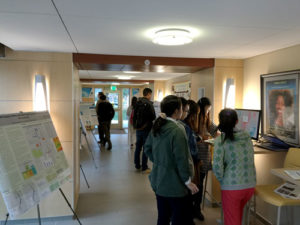
Martin was invited to speak about his new book, American Geography and Geographers: Toward Geographical Science, which was published in 2015 by Oxford University Press. However, his talk was as much an account of his own career-long journey to collect material and write about the history of American geography as about the book itself.

As a young academic, Martin was drawn to three figures in American geography, who had shaped the discipline in the first half of the twentieth century: Mark Jefferson, Ellsworth Huntington and Isaiah Bowman. All studied at Harvard under William Morris Davis, the man who played a founding role in the establishment of the academic discipline in America. While Davis’s work focused on ‘physiograhy,’ his three disciples pursued new directions in geography which examined the physical earth as the home of man: Jefferson with anthropography; Huntington with physical climatology; and Bowman with the concept of region.

Over the years, Martin systematically collected archival information on the life and work of these three geographers which was published respectively as Mark Jefferson: Geographer (1968), Ellsworth Huntington: His life and thought (1973), and The life and thought of Isaiah Bowman (1980).

Following the publication of this trilogy, Martin then set out on a grander project: to tell the larger story of American geography and geographers. The recently published title covering the period from 1870 to 1970 took 17 years to research and write. It is a testament to Martin’s meticulous attention to detail — pursuing every lead, uncovering every possible manuscript, and tracking down every living person to interview.

Martin is an archivist extraordinaire. In the course of more than five decades of research, he visited 17 countries, consulted 300 archival holdings, accumulated 115,000 manuscripts, and personally corresponded with more than 100 people.

What came across during his presentation was Martin’s sense of sheer pleasure and privilege at being able to work with the living relatives of the key scholars in the book, including weekly lunches with Ellsworth Huntington’s wife and four successive summers spent in the basement of Isaiah Bowman’s son, Bob. He also told stories about some of the challenges and frustrations of working with archival material, from a will that prevented access for 50 years (which he negotiated with the family down to 25 years) to a son who ceremonially burned manuscripts from his father’s archive from time to time. During the Cold War, he also had to defend himself during the McCarthy investigations after a colleague turned him in for allegedly being a Communist sympathizer. The unjustified evidence was a small set of Russian books on chess strategies from when he was a world-class champion of the game.

Martin, now in his early 80s, is truly of the old school. He has not embraced modern technology, which makes one respect his research and writing even more — from his correspondence carried out by hand-written letter to his dedication in answering geography questions via telephone at any time of day or night.

Martin’s expansive and in-depth knowledge of the history of geography and geographers is unparalleled. Through his exposition of the main characters in American geography, one feels to have actually met them personally. The joy of listening to Geoffrey Martin is the combination of hearing an authoritative scholar, as well as an entertaining raconteur.

Sadly, these days the history of geography is not a particularly popular sub-discipline, but geographers of all ages and all nations ought to pay heed to Geoffrey Martin’s landmark text, American Geography and Geographers.

Ralph Ehrenberg, Chief of the Geography and Map Division at the Library of Congress, and Douglas Richardson, Executive Director of the AAG, took the opportunity to not only honor Martin at Thursday’s event, but also to introduce the recent agreement of the consolidation of the AAG’s century-plus old archives to the Library of Congress. Collections are currently being moved from several scattered locations to this central place, which will make many important and rare materials available to scholars and historians worldwide. In celebration of this, and to complement Martin’s talk, the Geography and Map Division displayed unique and rare historic maps, documents and other artifacts.

    Share

Kirstin Dow Named Among First Leshner Leadership Institute Public Engagement Fellows at AAAS

Fellows to focus on climate change issues in first year of program

Kirstin Dow, a University of South Carolina geography professor and former AAG National Councillor, has been named an inaugural fellow of the American Association for the Advancement of Science’s (AAAS) Leshner Leadership Institute.

All members in this first cohort of 15 fellows are climate scientists with an interest in promoting dialogue between science and society.

“AAAS is encouraged by the interest in this new Public Engagement Fellowship opportunity. The 15 Fellows selected, and the many others who applied, demonstrate clear commitment in the climate science community to engage the public on this critical issue,” said Tiffany Lohwater, Director of Meetings and Public Engagement at AAAS. “The fellowship program is focusing on climate with its first scientist cohort, building on the long-standing commitment of AAAS to science communication and public engagement.”

Leshner Fellows will spend a week in Washington, DC, during June at the AAAS headquarters to focus on “public engagement and science communication training, networking and plan development.”

According to a statement from the University of South Carolina, “Dow is principal investigator of the Carolinas Integrated Sciences and Assessments, an interdisciplinary research team that bridges climate science and decision-making. She has also engaged public concerns as a lead author on the Intergovernmental Panel on Climate Change Fifth Assessment, Working Group 2 report and author on the U.S. National Climate Assessment (2014).”

The Leshner Leadership Institute was established in 2015 with support from more than 130 philanthropic gifts. It is managed by the AAAS Center for Public Engagement with Science and Technology, established by former AAAS Chief Executive Officer Alan I. Leshner in 2004.

More on the Net:

    Share

Race, Ethnicity and Place Conference Is Coming to Historic Kent, Ohio

REP VIII in Kent, Ohio: experience a small-town, urban environment with access to much more

The eighth bi-annual Race, Ethnicity and Place Conference (REP VIII) will be held September 21-23, 2016, at the Kent State Hotel, locally hosted by Kent State University

REP VIII already has attracted more than 150 registrants at the time of this publication, representing a wide range of disciplines, and scholars from numerous states and nations who share an interest in racial and ethnic transformation of places worldwide and reflect a mix of applied and theoretical perspectives. Along with paper, poster, and panel presentations, the conference features a welcoming reception at the Kent State Hotel on Wednesday evening, two lunches and a gala dinner.

For geographers and those of similar interests, the city of Kent is almost as interesting and important as the scholarly content of the meetings, so the REP Planning Committee has organized a number of opportunities to explore local landscapes and experience the sights, sounds, and tastes of local culture, as well as historic and ethnic places.

Kent, Ohio, provides a unique setting for this conference. The city recently experienced a place-remaking due to a $100 million investment. Its new award-winning, mixed-use, downtown is connected to the KSU campus through walkways. Our host hotel, the Kent State Hotel, provides direct access to the walkways that provide a pleasant atmosphere for viewing the campus. Kent State University gained international attention through a nationwide student strike in 1970, when the Ohio National Guard shot several students during a peaceful demonstration following the invasion of Cambodia during the Vietnam War. A very informative museum provides a first-hand look at this experience and the national climate of the time. A geography major was one of four students that spoke with President Nixon afterwards.

Of course, today Kent State University is a thriving Division I research institution and there is much to see on the campus. All conference participants and their accompanying family members are invited to partake in a self-directed tour of the Kent State Campus. KSU will provide maps, directions, and other information for these personalized excursions at the conference hotel.

Kent is located in Northeastern Ohio, only 40 miles from Cleveland, one of the nations’s most ethnically diverse populations, and is even closer to Akron, the former “Rubber Capital of the U.S.” Kent also is near Ohio’s “Amish Country,” which is one of the world’s largest settlements of Amish who separated from the Mennonites and persevered in maintaining the cultural elements of a rural European culture. These and other landscape features provide field trip options available on the days of the conference.

The REP VIII Conference closes on a traditional festive note with a gala dinner that provides entertainment and promises to be a fun event without speakers. Attendees are encouraged to wear ethnic dress, which results in many photo opportunities.

REP VIII is sponsored by its partners, sponsors, and private donors. For a listing and information about serving as a sponsor, see the REP Conference website, https://rep-conference.binghamton.edu (or search REP Conference 2016). Additional, regularly updated, information about the REP VIII is also posted on the Conference web site.

    Share