Marble Fund Seed Grant Award for Computational Geography
The deadline for the upcoming 2027 AAG awards has passed.
The biennial Marble Fund Seed Grant Award for Computational Geography provides seed grants to US-based early career faculty* seeking external funding in computational geography. Computational geographic research is done across many fields, including geography, computer science, statistics, mathematics, engineering, and more. Seed grants of up to $8,500 are available to researchers at US institutions who are eligible to serve as a PI on national or private grant applications. The award is one of the activities of the AAG Marble Fund for Geographic Science, which also includes the Marble-Boyle Undergraduate Achievement Award, the Marble Fund Award for Innovative Master’s Research in Quantitative Geography, and the biennial William L. Garrison Award for Best Dissertation in Computational Geography.
The Marble Fund is positioned to support up to 2 proposals in a single award period.
A seed grant is intended to allow the researcher to develop a proof-of-concept and perhaps early-stage research that will lead to a fundable proposal. In the seed-grant application, we are looking for innovation, new ideas, advancing the theory, tools, techniques, and methods associated with computational geography.
*Early career faculty are individuals who have earned their PhD within 10 years of the application deadline.
What does the funding support?
Seed grants from Marble Fund can be used for any of the following:
- Course/teaching release. Some researchers need time off from teaching to prepare a proposal.
- Travel. Funds may be used to pay for travel necessary for the development of a research proposal.
- Student workers. Support for student workers, either graduate or undergraduate, will be in the form of hourly student-worker wages.
- Software and data relevant to the proposal.
- Collection of preliminary data, including surveys, in-depth interviews, or workshops.
The Marble Seed Grant does not fund:
- Venture capital
- Humanitarian activities
- Construction, lobbying, personal loans, endowments, capital equipment
- Publication fees are not supported.
- Conference travel to present research findings
Budgets
Applicants should provide a detailed budget based on the linked template.
- Up to $8500
- Facilities & Administrative (F&A) Costs (indirect costs): limited to 5% of direct costs
Eligibility
Early career scholars at a US institution who are eligible to apply for a grant or contract from agencies for support of research (external to their own institution) are eligible to apply for the Marble Fund Seed Grant award.
Criteria
- Title of the seed grant proposal, name of Principal Investigator (PI), and contact information
- A summary of the work to be done (up to 1500 words), including a specific description of how the seed grant work will lead to a research proposal
- Bibliography
- Budget, with justification (must include any university financial commitments)
- The PI’s current CV, which includes the most relevant publications (5-page limit)
- A specific description of at least one funding agency where the researcher will submit a proposal. For agencies that allow contact with program officers, the proposer must include (1) the name and (2) email address or phone number of a program officer, and a summary of the discussion had with that program officer. For agencies that require letters of intent, include a copy of that letter and any response from the agency.
Required Deliverable(s) for Awardees
- The deliverable for the Marble Fund Seed Grant is a proposal, submitted to an external granting or contract agency within the project timeline.
- Scientific/technical and budget report after 24 months
- When and where was the proposal submitted, including confirmation of receipt by the funding agency
- How was the funding used
- Awardees will be invited and encouraged to attend the AAG annual award ceremony where seed grant winners will be recognized. Travel grants of $1000 will be provided for awardees who attend in person.
Applications
All nomination materials must be in English, and submitted in electronic form.
A complete application must be received no later than the close of business on the deadline (Eastern Time).
For questions or difficulties, please contact grantsawards@aag.org or call the AAG at 202-234-1450.
Reports and Acknowledgment:
The winner should acknowledge the award from the AAG Marble Fund for Geographic Science in subsequent presentations and publications arising from the proposal or research.
Trustees of the Marble Fund for Geographic Science
Dr. Jay Sandhu, ESRI
Dr. Donna Peuquet, Pennsylvania State University
Dr. Elizabeth Wentz, Temple University

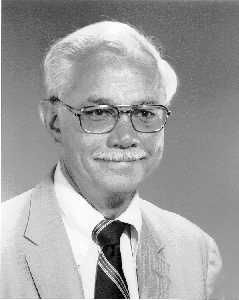 William L. Garrison who, following service in World War II, received his Ph.D. in Geography from Northwestern University in 1950. While a young faculty member at the University of Washington, Garrison became one of the leaders of the resurgence of geographic science and many of his doctoral students (including Duane Marble, Brian J. L. Berry, John Nystuen, Arthur Getis, Richard Morrill, and William Bunge) were subsequently instrumental in the evolution of geographic science and geographic information systems. Bill Garrison was also one of the first geographers to make use of computational approaches to the solution of geographic problems. The early work at the University of Washington of Garrison and his students involved such historic computing systems as the IBM 604 and IBM 650. Garrison was Professor Emeritus of Civil and Environmental Engineering and Emeritus Research Engineer in the Institute of Transportation Studies, University of California, Berkeley.
 The Glenda Laws Award is administered by the American Association of Geographers and endorsed by members of the Institute of Australian Geographers, the Canadian Association of Geographers, and the Institute of British Geographers. The annual award recognizes outstanding contributions to geographic research on social issues. This award is named in memory of Glenda Laws—a geographer who brought energy and enthusiasm to her work on issues of social justice and social policy. All early to mid-career scholars involved in geographic research on one or more social issues will be eligible for this award. Nominations should include two letters of recommendation from scholars or members of community organizations familiar with the research upon which the nomination is based, a curriculum vitae, and a scholarly paper based on original research.




















 Melvin G. Marcus, past president of the American Association of Geographers and an internationally recognized physical geographer, structured his career around a balance of field work, theory development, teaching, and enjoyment of the geographic endeavor. Making physical geography accessible to everyone with a love of the outdoors, including women, minorities, and the less privileged, was one of Mel’s life-long objectives.