

AAG’s visual identity reflects our mission to advance geographic understanding and foster connections across communities, disciplines and places. These guidelines are intended to help staff, partners, vendors, consultants and collaborators create materials that are consistent, professional and recognizable across print, digital, video and event communications.
By using AAG’s approved logos, colors, typography and visual standards, partners help strengthen a unified brand presence while maintaining the flexibility needed for diverse audiences and projects.
Materials created on behalf of AAG should follow these visual identity guidelines to ensure consistency across communications, platforms and partnerships. Questions regarding logo usage, co-branding, or visual standards should be directed to AAG before publication.
Color palette
AAG’s primary colors are dark blue, red and gold. Dark blue serves as the foundation of AAG’s visual identity and is used prominently across our website, publications and communications materials. Gold functions as a secondary accent color, often appearing in text, highlights or decorative elements, particularly when dark blue is used as a background. The presence of red indicates action and is used for calls to action (CTA) across the site, as well as within the Advocacy section.
| Dark blue | Primary color (used on headlines, etc.) | #052A47 | |
| Gold (tan) | Secondary color (used on dark blue background) | #C7A98C | |
| Raspberry red | Action color (used sparingly for CTAs, etc.) | #E44A50 |
Type usage
AAG uses two font families: PT Serif and Open Sans. PT Serif is most often used for dominant headlines of various sizes, while Open Sans is used for subheads and body text. Both can be used for graphics, depending on style.
PT Serif
Open Sans
| H1 | Page hero, post headline | PT Serif |
| H2, H3 | Page/post headings, subheadings | PT Serif |
| H4 | White bold heading | Open Sans |
| H5 | Sans serif subheads, etc. | Open Sans |
| H6 | All caps red/white heading for labels | Open Sans |
| P | Sans serif paragraph text | Open Sans |
| Red-large | CTA large red button | Open Sans |
| Red-small | CTA small red button | Open Sans |
| Text-CTA-red | CTA red text with arrow | Open Sans |
Logo styles
The AAG logo is the primary visual identifier of the organization and should be used consistently across all communications. Approved logo files are available in several formats and configurations to accommodate different applications while maintaining a cohesive visual identity.
AAG’s logo includes the Berghaus Star as its seal. This map projection was incorporated as the AAG logo in 1911. The font used within the logo is Trajan Pro. The logo is displayed in various ways:

AAG seal
Includes AAG’s full name, founding year and Berghaus Star within a circle.
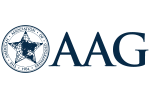
Acronym
Displays the AAG seal and the acronym.
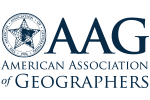
Full name
Includes the AAG seal, acronym and full name.
Acceptable Use
DO:
- Use approved AAG logo files
- Maintain the logo’s original proportions
- Use official AAG colors or approved single-color versions
- Provide adequate clear space around the logo
- Choose the logo variation that best suits the available space and format
DON’T:
- Stretch, compress, rotate, or distort the logo
- Alter logo colors
- Add shadows, outlines, filters, or other effects
- Rearrange logo elements
- Place the logo on backgrounds that reduce legibility
- Incorporate the logo into another organization’s logo or mark
Clear space
To ensure visibility and impact, leave sufficient clear space around the logo on all sides. As a general guideline, maintain a minimum amount of padding equal to the height of the capital ”A” in the AAG wordmark. No text, graphics or page elements should enter this area.
* * *
Official AAG logo files are available in formats suitable for print, web, presentation and video production. If you require a specific file type, logo variation or application guidance, please contact AAG before creating new artwork or modifying an existing logo file.
Organizations, media outlets, sponsors and project partners wishing to use the AAG logo should request approval prior to publication. This helps ensure proper representation of the organization and consistent use of its visual identity. When submitting a request, please include your intention for use, as well as where you plan to use it (digital, print, large signage, etc.). We will provide the appropriate logo once we grant approval.
Photography and illustration guidance
AAG visuals should reflect the breadth, diversity and relevance of geography in research, education, professional practice and public life. Whenever possible, imagery should emphasize authentic experiences, meaningful engagement and real-world connections between people, places and environments.
Preferred imagery includes:
- Fieldwork, research and data collection
- Mapping, spatial analysis and geographic technology
- Geography education and student engagement
- Community-based projects and partnerships
- Natural and built environments
- Diverse geographic perspectives and experiences
Photography and illustrations should feel authentic, informative and welcoming. Avoid overly staged corporate imagery, generic business stock photography or visuals that do not clearly connect to geography, place, exploration, education or geographic inquiry.
Accessibility and collaborative use
AAG is committed to creating communications that are accessible, inclusive and effective for diverse audiences. Partners and vendors producing materials on behalf of AAG should follow accessibility best practices whenever possible.
These practices include:
- Maintaining sufficient color contrast for readability
- Using clear and legible typography
- Providing alternative text for digital graphics and images
- Including captions or transcripts for video content
- Avoiding visual elements that may create barriers for users with disabilities
When developing co-branded materials, the AAG logo should remain distinct from partner logos and visual identities. Partner organizations may be recognized alongside AAG, but logos should not be combined, altered, or presented in ways that imply organizational endorsement beyond the scope of the partnership.
If questions arise regarding logo usage, co-branding, accessibility or visual standards, AAG will review materials and provide guidance before publication.