Department Profile: Geography and Geoinformation Sciences at George Mason University
The Geography and Geoinformation Sciences (GGS) Department at George Mason University is fortunate in its Fairfax, Virginia location, close to many professional opportunities in and around the nation’s capital. Anchored in the center of Northern Virginia’s geospatial intelligence hub, surrounded by federal headquarters like the National Geospatial-Intelligence Agency (NGA), US Geological Survey (USGS), and the National Oceanic and Atmospheric Administration (NOAA), as well as leaders in the private sector like Esri, Dewberry, and BAE Systems, GGS can also connect its students and alumni to local government agencies such as Fairfax County’s GIS and Mapping Services.
The department’s breadth is revealed in its name. “We are not the Department of Geography, but we are the Department of Geography and Geoformation Science,” says Dr. Deiter Pfoser, department chair and director of the Center for Geoscience. “So, there’s a huge distinction there … it sort of alludes to the quantitative sides [of the discipline].” Dr. Nathan Burtch, associate professor, undergraduate coordinator and associate chair, agrees.
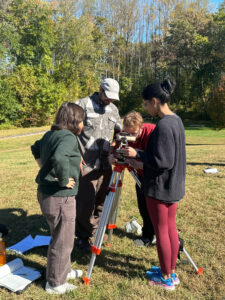
This emphasis on the quantitative is a major incentive of the program, as the majority of the department’s students are pursuing a Bachelor of Science degree and thinking about careers. Students pursuing a BS in geography can choose from concentrations in Geoinformatics, Geospatial Intelligence, and Urban Science, which are marketable and easily conceptualized by employers.
The department’s research initiatives, which have an annual expenditure of approximately six million dollars, largely trend around topics like artificial intelligence, computational analysis, and informatics. Students researching remote sensing have access to a collection of advanced drone remote-sensing equipment, including DJI drones and interchangeable sensors for environmental and infrastructural studies. Dr. Pfoser points out that the program emphasizes “not only geographical proximity to [many geospatial] agencies, but also work proximity.”
The university and the department’s faculty and leaders involve students in research as early into their academic journeys as possible. The College of Science’s Aspiring Scientists Summer Internship Program (ASSIP) has been active in providing high schoolers and undergraduate students the chance to engage in faculty-mentored research opportunities since 2019. The GGS department has eight prospective mentors for the 2026 session, tackling research interests like spatiotemporal computing, space weather, and food systems transformation. Dr. Pfoser expresses that “the idea is really to bring students closer to research as soon as we can,” to develop students into exemplary undergraduate, graduate, and PhD researchers.
Graduate degree offerings reinforce the department’s quantitative focus, with a master’s degree in Geoinformatics and Geospatial Intelligence. Undergraduate students interested in this degree, or the master’s in Geographic and Cartographic Sciences, can enroll in the Bachelor’s to Accelerated Master’s (BAM) Program and collect graduate credits in their final undergraduate semesters. In addition to offering accelerated, master’s, and doctorate pathways, the department also promotes a culture of lifelong learning by offering graduate certificates in GIS, Geospatial Intelligence, Environmental GIS and Biodiversity, and Remote Sensing and Image Processing. Executive education partnerships with local companies allow working professionals to advance their skills through the guidance of university course content.
An Interdisciplinary Approach to Quantitative Geography
“We’re a little bit more quantitative than the average,” says Dr. Burtch, “But we don’t ignore the cultural and the physical as well.” The GGS department’s Bachelor of Art’s geography program offers concentrations in environmental geography, health geography, geoanthropology, and urban planning. The professors teaching courses in this degree are consistently enthusiastic about their subjects, welcoming students to think critically and exercise real-world problem solving.
The department also values cross-disciplinary exploration. Undergraduate students can choose from a variety of elective courses that traverse neighboring disciplines. Associate professor and BAM advisor Dr. Christine Rosenfeld teaches Spatial Justice, for example, a geographic interrogation of unevenly distributed resources that results in social inequality. Dr. Maction Komwa teaches Geography of Resource Conservation, an analysis of the distribution and preservation of global resources. Dr. Burtch teaches Geography of Sport, purposefully integrating the discipline to reveal surprising explanations about the geography of the sports industry.
The strong sense of student community, accessible advising, and welcoming faculty make the GGS department at GMU an optimal learning environment for students of diverse education and career backgrounds. Standards for teaching excellence are maintained by routine faculty peer review, end-of-semester evaluations, and course modality surveys. The department uses this feedback to support their mindset of “perpetual change” and implement improvements to keep up with the ever-evolving scene of higher education.
Diversity is a big part of George Mason’s identity as an institution, as it is one of the most ethnically and economically diverse schools in Virginia. Dr. Pfoser highlighted the disciplinary diversity of the department by noting that only about half of its faculty are geographers by training. In addition to the interdisciplinary course offerings, the department offers diverse teaching perspectives from career computer scientists, hydrological engineers, environmental geographers, and data scientists. This combination of curriculum, teaching, and student diversity creates classroom environments suited for positive learning experiences.