Maps as ‘Materials that Carry Memory’

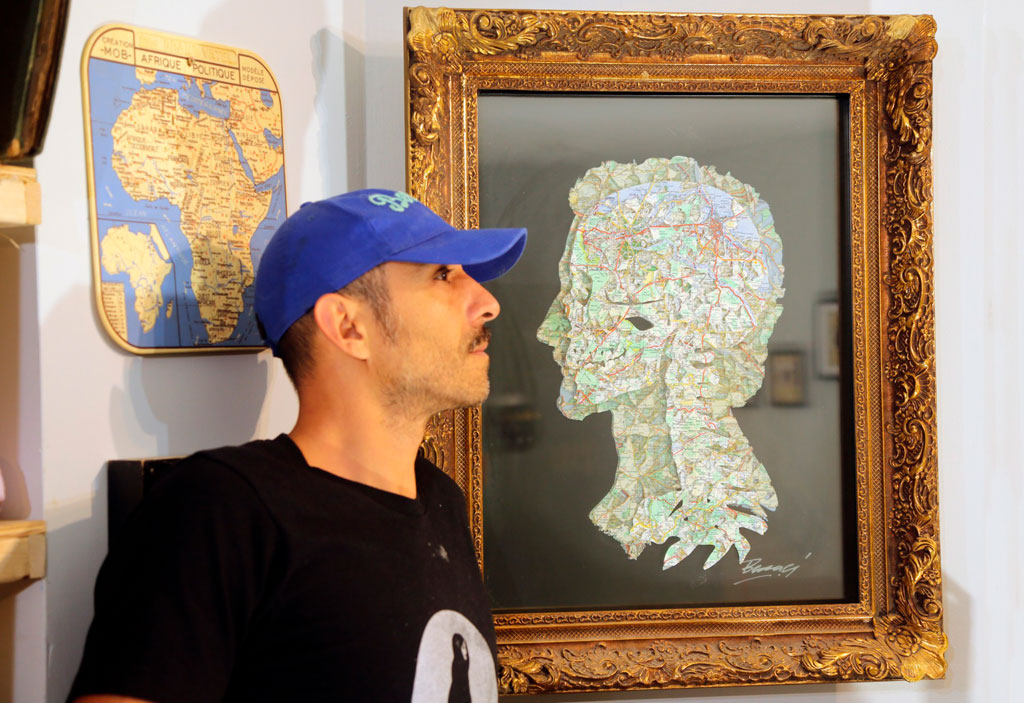
Joanathan Bessaci poses showing his profile facing his artistic rendering of a profile. Courtesy: Joanathan Bessaci
Joanathan Bessaci with his art. Courtesy: Joanathan Bessaci


When artist Joanathan Besacci was growing up in Lyon, France, he was surrounded by the vast variety of the world, past and present. His maternal grandmother emigrated to France from Vietnam, and his paternal grandfather was from Kabylia (Northern Algeria). As a child, Bessaci spent hours watching his artist father work and exploring the flea market in Lyon, France, where his grandparents had a stall.

The flea market was a magical place, he says, “a doorway to other worlds.” His memories of it go back to 1986, when it was still called La Fecine, in Villeurbanne, set up on a street closed on Sunday mornings. In the 1990s, it moved to Vaise, and by the end of the decade, it found its current home: Les Puces du Canal.
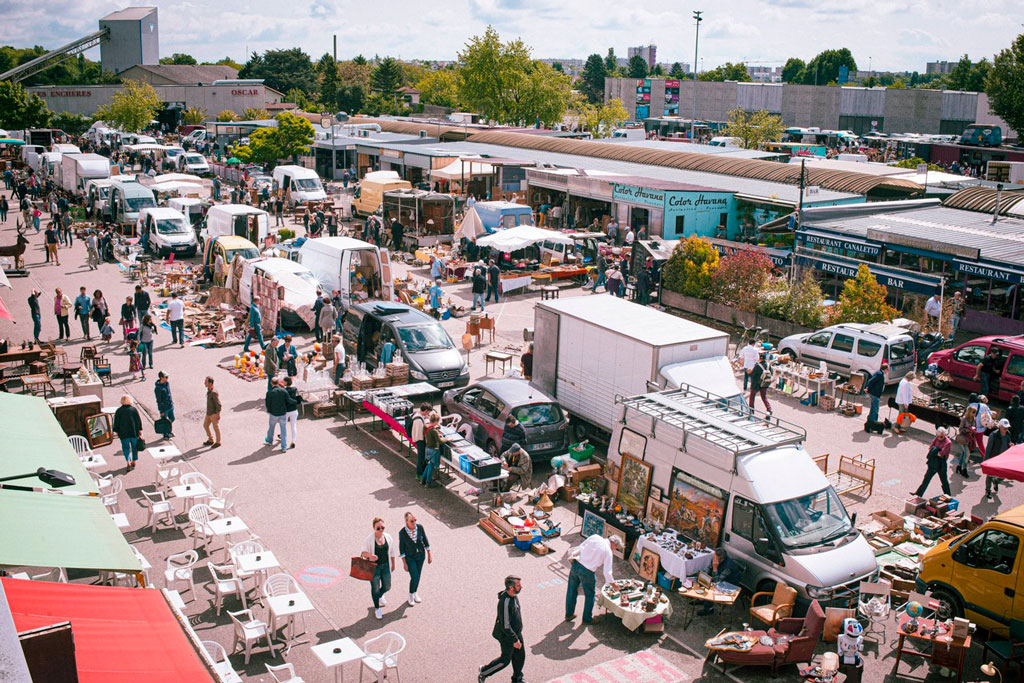
Aerial view of a flea market in Lyon. Courtesy: Joanathan Bessaci
Flea market in Lyon. Courtesy: Joanathan Bessaci


“I went there as a child, still half-asleep but filled with excitement,” Bessaci recalls. “My grandfather arrived as early as 4 a.m.; I followed my father around after 5 a.m. You had to get up early to hope for a good spot. Sometimes sales began right in the trucks, under the flickering light of flashlights, before the sun had even risen.”

It was here that he first discovered the maps, books, and old photographs that now form the essential materials of his art. “They carried stories, past lives, fragments of humanity which, though I didn’t realize it yet, would become the very substance of my work.”

The flea market also influenced Bessaci’s fascination with the riddles presented by old objects and artifacts, “guessing what an object had been used for, what life it had lived, who had touched it before me. In some maps, I find traces of passage—a handwriting, a stain, a tear. These marks of time move me deeply. They make each piece unique, irreplaceable, like an imprint left by history. It is in this intimate relationship with objects, memory, and enigma that my artistic practice took root.”

Bessaci started as a graffiti artist, in his teens. His work evolved over time into the elaborate paper cut-out sculptures, using maps and photographs, that he makes today. At art school, he says, “I discovered the relationship to time. Coming from graffiti, where everything must be done in urgency, I was stunned to learn that a single project could take 80 to 100 hours of work. At first, it was a trial, almost a violence against my rhythm. But little by little, this temporality became an obviousness, a new kind of breathing.”

Now based in the United States, Bessaci continues to develop his practice and present his work in exhibitions and art fairs. He draws inspiration from antique Michelin road maps, primarily from the 1920s to the 1970s. He combines them with photographs and vintage textiles to create works that blend the markers of human individuality with topographies and routes. “My process is instinctive, almost archaeological,” he told Bold Journey magazine in 2025. “I collect, cut, layer, stitch. Each gesture is an attempt to surface memory, to retell what we think we already know.”
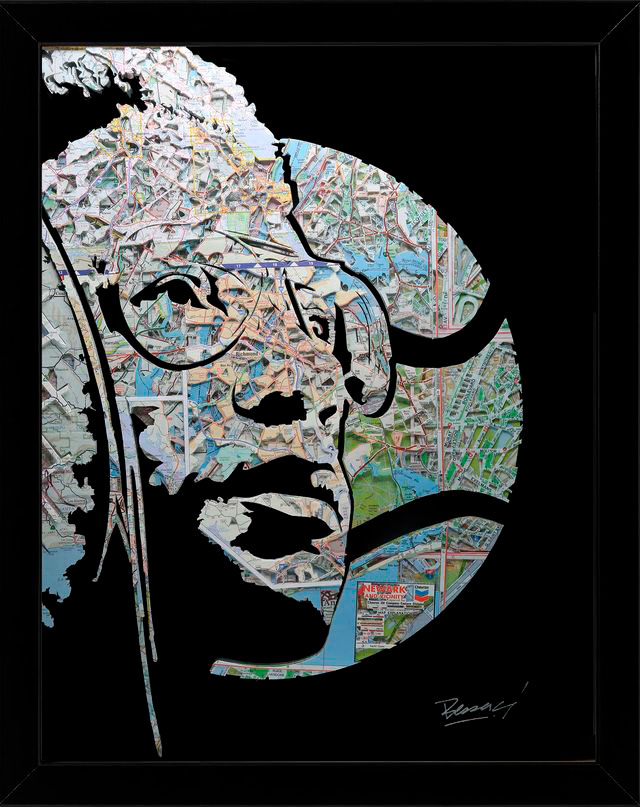
Artist's rendition of a portrait of Arthur Ashe. Courtesy: Joanathan Bessaci
Portrait of Arthur Ashe. Courtesy: Joanathan Bessaci


The maps Bessaci includes in his art create what he calls “layered stories.” The roads and rivers become metaphors for “chosen or imposed paths, uprooted or rediscovered roots.” The cuts, overlaps, and fragmentation he imposes are ways to question his subjects, and to challenge the idea of the subject as fixed. He seeks to portray “something in motion, composed of ruptures and recompositions.”

Bessaci had been primarily a painter for more than 15 years when he shifted his practice these sculptural works on paper. The change coincided with the birth of his daughter, and an extended period of time in a secluded studio in a very small town in France. On a visit to his grandfather at around this time, Bessaci received a box of old items, including old road maps. “It was as if the flea market had returned to my hands, charged with memory and secrets to be revealed.”

At first, Bessaci was reluctant to make any changes to the maps: “The day I dared to cut directly into a map, I felt an inner shift,” he says. “The maps immediately spoke to me: they were at once adventure, travel, and a profound resonance with my family, my memories of the flea market, and this need to explore the traces left by time.”

As Bessaci experimented and refined his technique, he began layering the maps, up to five layers at a time, to explore depth. The more he worked with old maps, the more he saw correspondences with people, and with memory and life itself: “The roads and rivers reminded me of veins, a living cartography of the body and of memory.”

Bessaci describes much of his raised work as bas-relief. He frames his cutouts between layers of glass and road maps, comparing them to mille-feuilles, a many-layered dessert. The layers create depth, “almost a vibration.”

Today, Bessaci owns nearly 5,000 maps, mainly Michelin, dating from 1890 to 1990.

“Their texture, their faded colors, their smell of ink and aged paper fascinate me,” Bessaci says. “A map is a displacement, an adventure, but also an anchor. It helps us know where we are, and I like to believe it also helps us know who we are.”

Bessaci is now working on a new series he calls Roots and Paths, using the kinds of photographs that turn up at flea markets, secondhand stores, and estate sales, devoid of their original context and family connections. Bessaci cuts the people from these images, leaving only their silhouettes, emphasizing their gestures. His goal is to neutralize “any visible markers of race, gender, and age, allowing the viewer to project their own memories, their own emotional history.” In place of the removed material, he fills in map fragments—roads, rivers, mountain ridges—as “layers of inner geography.”

He can foresee many years—perhaps a lifetime—of working with maps as an artist. “Maps, more than any other medium, have something magical: I don’t feel like I chose them—they found me,” he says. “They reflect my identity, but also the memory of my family, of places, of stories that shaped me. What I love is that they never fully reveal themselves. They hold secrets, hidden stories. I like to slip clues into my works, and sometimes, years later, a collector tells me: ‘I’ve just discovered this detail.’ At that moment, I feel that the map keeps speaking, long after me, as if it carried its own narrative.”
    Share

Wayfinding: ‘Mapping Justice’ GIS Course Empowers Teens to Highlight Issues in their Communities 

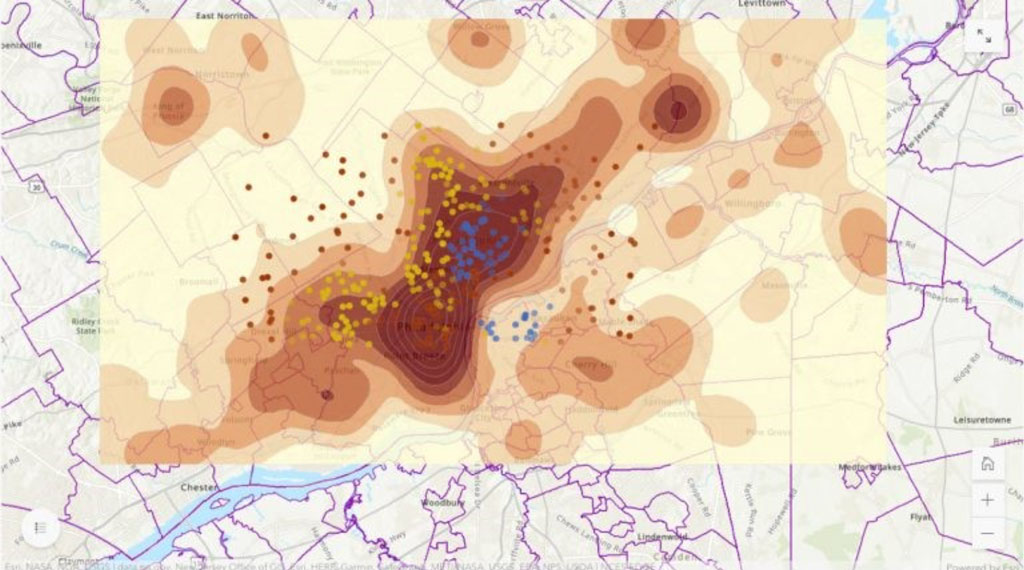
Map developed by Mapping Justice student team Oluwaseun Ogundimu and Ruhe Solomon shows how fast food outlets correlate with poverty in Philadelphia. To make the map, the coordinates of fast food locations were layered over Census tracts showing race and income. See the original StoryMap.
Map developed by Mapping Justice student team Oluwaseun Ogundimu and Ruhe Solomon shows how fast food outlets correlate with poverty in Philadelphia. To make the map, the coordinates of fast food locations were layered over Census tracts showing race and income.

With a donation of $50,000 from Esri, AAG has embarked on a partnership with the new educational platform trubel&co, aiming to connect college geography departments with high school students in their area who could take part in Mapping Justice workshops. AAG and trubel&co debuted the partnership at AAG 2023 in Denver, and are growing the concept to help AAG members discover the program’s potential for attracting high school students, especially students from historically and currently marginalized groups in the field of geography, whether because of racialization, economic status, family history of access to college, or gender or sexual identity. 

With the goal of leveraging spatial analysis as an integral part of STEM learning and civic innovation, Mapping Justice began as a 2020 course at Massachusetts Institute of Technology (MIT) Online Science, Technology, and Engineering Community (MOSTEC). Founder Nick Okafor encouraged students to connect their concerns and passions with the communities and landscapes they knew—and to see those places in entirely new ways through the power of mapping. Topics included transportation inequities, climate change, discrepancies in food access, gentrification, the digital divide, voting disparities and gerrymandering, and educational inequities. Students work collaboratively, usually in pairs, on every aspect of their projects.  

“STEM is extremely collaborative,” Okafor told an interviewer for Esri in 2022, “so I want them to start building these skills early.” 

In 2022, Okafor and co-founder Alani Douglas formally incorporated trubel&co (pronounced “trouble,” as in “good trouble”) to scale the project up throughout the United States. With a team of six other practitioners, trubel&co has an ambitious vision to “champion diverse high school youth to design geospatial tools for social change, using GIS (Geographic Information Systems) to promote equity within their community.” The Mapping Justice curriculum is one effort of the rapidly growing organization, and is intended to build core technical competencies, critical thinking, spatial thinking, data fluency, self-direction, collaborative skills, and cultural awareness. 

The team at trubel&co is also branching out into service learning, notably through the month-long Resilient Civic Futures hackathon in Fall 2023, which mobilizes college students with GIS skills to work with truble&co and cosponsor Earth Hacks to “tackle environmental justice challenges in partnership with community-based organizations through the creation of geospatial tools.” 

Submit this online form to inquire about hosting a Mapping Justice workshop by trubel&co. For further questions, please contact [email protected].

DOI: 10.14433/2017.0135


StoryMap source of featured map image of fast food outlets correlating with poverty in Philadelphia.

    Share

Wayfinding: Tracing Pandemic Geographies Across Time

U.S. Department of State C2M2 base map
Credit: U.S. Department of State

Before COVID-19 locked down the world, AAG member Melinda Laituri was a world traveler. As director of the Geospatial Centroid at Colorado State University and principal investigator for participatory mapping programs for the U.S. Department of State’s Office of the Geographer, she used technology to stay connected to the world: “I have been exploring the world at my fingertips through virtual travel to exotic locations” she writes at the beginning of the book she co-edited during COVID-19. “I have visited places I never thought to explore before—Chernobyl, Mars, and Iceland’s oldest shipwreck. It isn’t quite the same but does fill a bit of the void.”

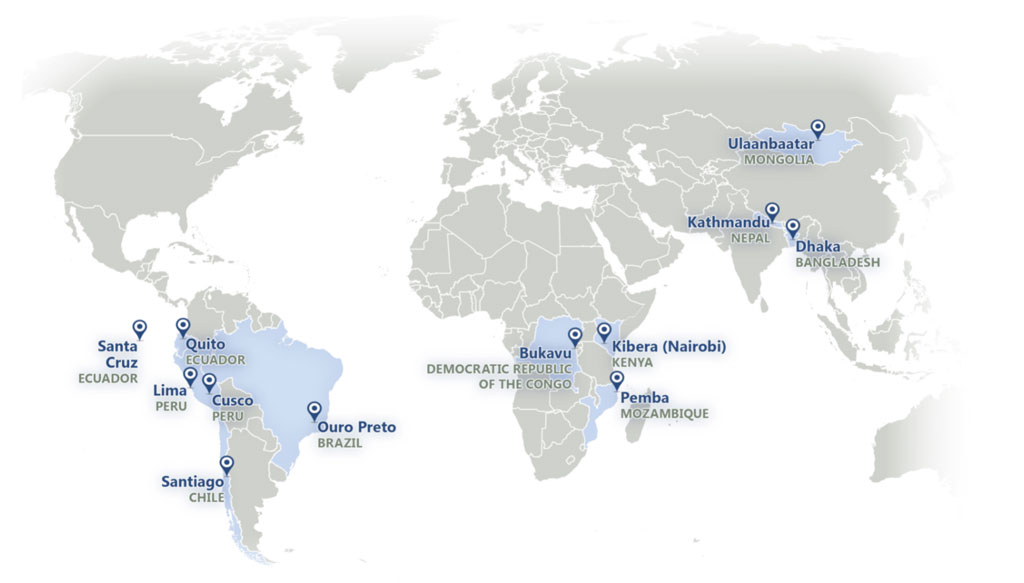
Laituri also channeled her love of place and adventure into her work with the Department’s Cities’ Covid Mitigation Mapping (C2M2) program, working with three participatory mapping hubs in Africa, Asia, and Latin America. While program coordination was virtual, the city-level projects were very much physical, or sometimes hybrid: six sites in Latin America, three in Africa, and three in Asia. Projects varied: an examination of the pandemic’s impacts on domestic violence in Peru; an assessment of second-order impacts of COVID-19 (education, economic, healthcare) in several African cities; a crowd-sourced health access app in Mongolia; and a participatory project to map the pandemic impacts on tourism-related businesses in Nepal.  

The observations gained from this work are collected in The Geographies of COVID-19: Geospatial Stories of a Global Pandemic (Springer), a set of case studied co-edited with Robert B. Richardson and Junghwan Kim. The co-authors describe the spatialized impact of COVID-19 this way: “These geographies are located in both time and space, revealing impacts that are both immediate and long-term. The story of the pandemic is dynamic, in constant flux, and flush with ephemeral observations.”  

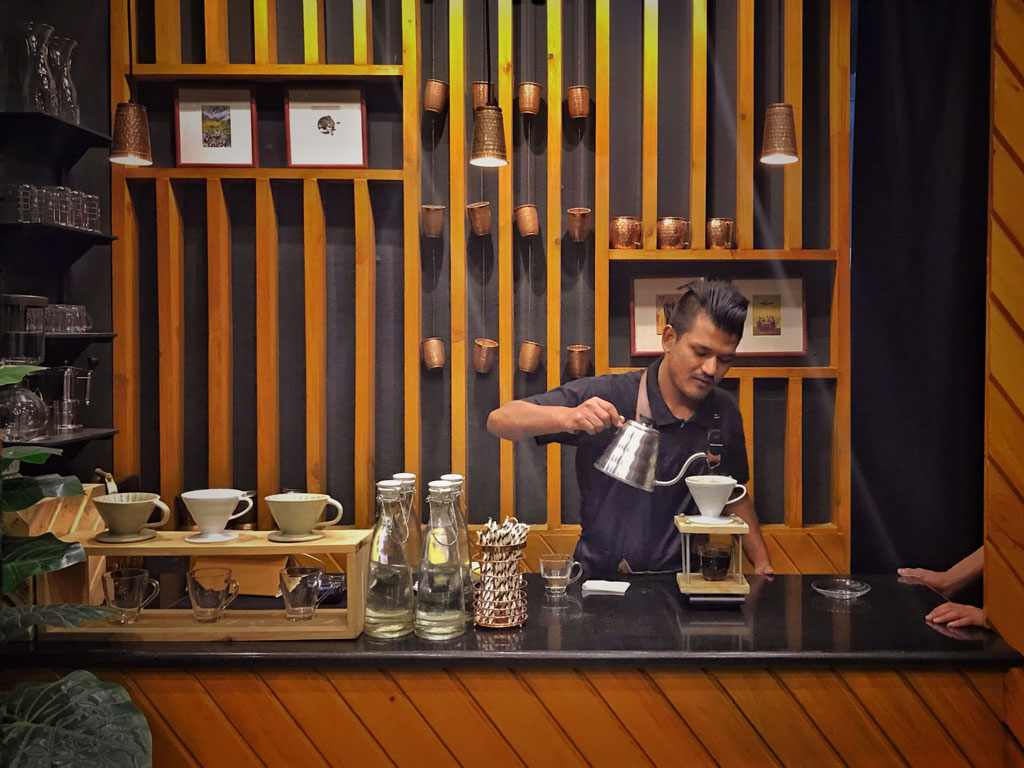
Photo of barista preparing a beverage in Kathmandu, Nepal. Credit: Rohit Khadgi
In Nepal, Asia Hub partner Kathmandu Living Labs compiled extensive information from tourism-based businesses to map and analyze the impact of COVID-19 on their livelihoods.


One through-line of the case studies is how a large-scale event like COVID-19 reveals and exacerbates the inequities of societies around the world. Across scales, distances, and cultures, these inequities and impacts are “compounded by the government and social responses,” the team found, but also hold the key to “revealing how geography and geospatial technologies can contribute to future solutions and adaptations.”  

Throughout their book, the editors consider the act and tools of mapping, and especially the dimensions introduced by live, dynamic, and interactive mapping tools, and cautioning the reader regarding the unintended consequences of decisions about such factors as data collection and scale. “Our stories are only as good as the data we have,” and the digital divide—uneven internet access, lack of access to phones and other devices–influences which data are included. “The data are constrained by what is collected (or not), how numbers are aggregated, the level of precision of data collection instruments, and algorithms. Maps and associated models are simplifications…” 

Additionally, the book highlights the need for practitioners of many disciplines to pool their knowledge for cross-cutting solutions. Citing the work of the World Health Organization in identifying 15 international laboratories “that coordinate with national labs around the world to increase connectivity within the science community,” Laituri et al say that such efforts can go forward still more efficiently with the support of the virtual geography based on shared data and geospatial tools for place-based, data-driven decision-making. Our responsibility as geographers and geospatial students, practitioners, and scientists is to ensure grounded, ethical, and sound scientific approaches in addressing the profound problems we face,” they assert.  

The Geographies of COVID-19: Geospatial Stories of a Global Pandemic is available from Springer. 

To find out more about the U.S. Department of State’s participatory mapping programs, see the MapGive website.

DOI: 10.14433/2017.0128

    Share

Wayfinding: A Map to Inspire Local Journeys 

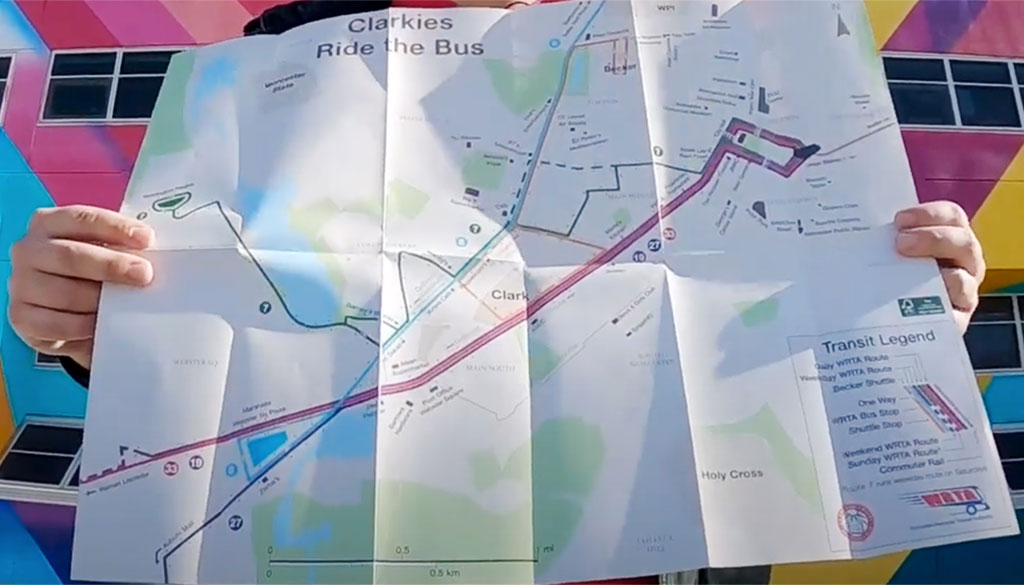
Geography and urban planning Ph.D. student Nick Mellis shows his walking and transit map of Worcester, Mass.

Grad Student Nick Mellis’s pocket map of Worcester is a passion project

Photo of Nick MellisWhen Nick Mellis was eight years old, he memorized the New York City subway map. He’s been a map and transit enthusiast ever since, majoring in geography as an undergrad at Clark University, and going on to pursue graduate studies in community and urban planning, also at Clark.
In 2020, Mellis launched a project to acquaint his fellow “Clarkies” with the transit system, sights, and open spaces of the university’s home of Worcester, Massachusetts. Mellis researched the best practices of tourism maps, hosted community discussions — and walked, biked, and rode the city’s trains and buses — a lot. The result is a map showing transit routes on one side, recreation and outdoor areas on the other — an especially welcome tool for respite from studies during the pandemic.

“I go on really long walks. It’s my way to de-stress,” Mellis told ClarkNow. “Part of the reason that I wanted to go to all the trails on the map was because I like exploring new places around the city.”

He also sees the project’s response to climate change, encouraging people to seek outdoor locations via public transportation. He observed that many of the students at Clark don’t know where green spaces are, nor how to access them:

A way to get more people around the city and on the bus is to make a map.

Mellis worked with a map printer in Denver to publish 2,500 copies of the map, which are available across campus.


Read more about Nick Mellis’s work at ClarkNow.

Find out about AAG’s network of graduate students at the Graduate Students Affinity Group

    Share

Wayfinding: Finding Heat Vulnerability Before It’s Too Late

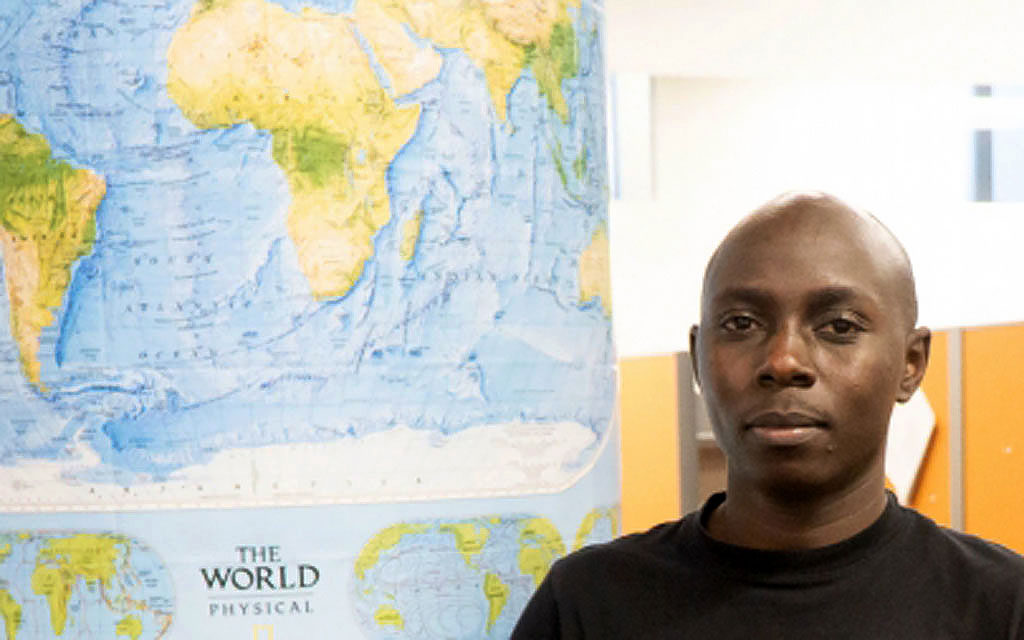
Photo of Joseph Karanja standing next to a map, courtesy David Rozul
Joseph Karanja, courtesy David Rozul

Joseph Karanja wants to change how cities confront heat risks to their residents.

Karanja, a graduate student in the School of Geographical Sciences and Urban Planning at Arizona State University, presented on the topic at the AAG annual meeting in February 2022. Karanja’s research, co-authored with Matei Georgescu, associate professor at the school, among other co-authors, creates an approach to evaluating heat risk that relies on more specific data and responsive analysis of the many factors that influence risk and make specific populations more vulnerable.

For example, “comparing outcomes in Maricopa County, homeless account for about 40% of the deaths, yet census datasets (the information that powers current heat-health modeling) cannot account for that population,” Karanja says. “We are simply relying on these data because of the absence of an alternative. I want to challenge that. I want to prompt people to think of alternative data sets and alternative ways of thinking.”

Nearly 3,000 people visit Arizona emergency rooms because of heat-related illnesses each year. Heat-related deaths have increased by more than 180 percent in the last decade. In 2020, there were 323 heat-related deaths in Maricopa County alone.

Karanja’s research combines a nuanced approach to datasets with statistical techniques that “unify disparate information to gain new perspectives on how communities are experiencing varying heat stress and heat-health impacts,” writes ASU’s David Rozul, resulting in “a new composite heat-vulnerability metric — a metric that combines not only biophysical (heat) data, but also socioeconomic data from various sources to give researchers and policymakers a finer lens into who is most heat-health vulnerable.”

Among the variables and differences Karanja’s methodology factors in are structures such as porches and coverings, income differences, access to air conditioning, and tree canopy. These are considered as parts of an evolving cycle that can act as a feedback loop, offering more information for prevention, intervention, and remedy.

Karanja sees heat risk research as a crossroads for addressing climate change, poverty, disparities, and urban resilience. “If you are to solve challenges tied to heat, to some large extent, you are dealing with climate change problems associated with population growth and rapid urbanization,” he says. “You’re, in a way, solving so many problems just by looking at heat in all its multi-dimensionality.”

Karanja hopes not only to help people in American cities through his research; he hopes to one day carry out similar research in his home country of Kenya.

“I have never met a student with a greater desire, an unquenchable thirst, to learn,” said Georgescu, who serves as Karanja’s academic adviser. “He is undaunted by challenges and is unfazed at immersing himself in completely new fields. Joseph is a future global star. I am very excited to be a part of the next three to four years of his experience at Arizona State University.

This article is adapted from an article by David Rozul, Arizona State University. Photograph courtesy of David Rozul.

Find out more about AAG’s work to address climate change
    Share

Wayfinding: Young Geographers Unearth Clue to Climate Change in the Andes

Photo of Joseph Karanja standing next to a map, courtesy David Rozul
Joseph Karanja, courtesy David Rozul

Joseph Karanja wants to change how cities confront heat risks to their residents.

Karanja, a graduate student in the School of Geographical Sciences and Urban Planning at Arizona State University, presented on the topic at the AAG annual meeting in February 2022. Karanja’s research, co-authored with Matei Georgescu, associate professor at the school, among other co-authors, creates an approach to evaluating heat risk that relies on more specific data and responsive analysis of the many factors that influence risk and make specific populations more vulnerable.

For example, “comparing outcomes in Maricopa County, homeless account for about 40% of the deaths, yet census datasets (the information that powers current heat-health modeling) cannot account for that population,” Karanja says. “We are simply relying on these data because of the absence of an alternative. I want to challenge that. I want to prompt people to think of alternative data sets and alternative ways of thinking.”

Nearly 3,000 people visit Arizona emergency rooms because of heat-related illnesses each year. Heat-related deaths have increased by more than 180 percent in the last decade. In 2020, there were 323 heat-related deaths in Maricopa County alone.

Karanja’s research combines a nuanced approach to datasets with statistical techniques that “unify disparate information to gain new perspectives on how communities are experiencing varying heat stress and heat-health impacts,” writes ASU’s David Rozul, resulting in “a new composite heat-vulnerability metric — a metric that combines not only biophysical (heat) data, but also socioeconomic data from various sources to give researchers and policymakers a finer lens into who is most heat-health vulnerable.”

Among the variables and differences Karanja’s methodology factors in are structures such as porches and coverings, income differences, access to air conditioning, and tree canopy. These are considered as parts of an evolving cycle that can act as a feedback loop, offering more information for prevention, intervention, and remedy.

Karanja sees heat risk research as a crossroads for addressing climate change, poverty, disparities, and urban resilience. “If you are to solve challenges tied to heat, to some large extent, you are dealing with climate change problems associated with population growth and rapid urbanization,” he says. “You’re, in a way, solving so many problems just by looking at heat in all its multi-dimensionality.”

Karanja hopes not only to help people in American cities through his research; he hopes to one day carry out similar research in his home country of Kenya.

“I have never met a student with a greater desire, an unquenchable thirst, to learn,” said Georgescu, who serves as Karanja’s academic adviser. “He is undaunted by challenges and is unfazed at immersing himself in completely new fields. Joseph is a future global star. I am very excited to be a part of the next three to four years of his experience at Arizona State University.

This article is adapted from an article by David Rozul, Arizona State University. Photograph courtesy of David Rozul.

Find out more about AAG’s work to address climate change
    Share

Wayfinding: In the Philippines, Local Knowledge Makes a Global Impact

Photo of Joseph Karanja standing next to a map, courtesy David Rozul
Joseph Karanja, courtesy David Rozul

Joseph Karanja wants to change how cities confront heat risks to their residents.

Karanja, a graduate student in the School of Geographical Sciences and Urban Planning at Arizona State University, presented on the topic at the AAG annual meeting in February 2022. Karanja’s research, co-authored with Matei Georgescu, associate professor at the school, among other co-authors, creates an approach to evaluating heat risk that relies on more specific data and responsive analysis of the many factors that influence risk and make specific populations more vulnerable.

For example, “comparing outcomes in Maricopa County, homeless account for about 40% of the deaths, yet census datasets (the information that powers current heat-health modeling) cannot account for that population,” Karanja says. “We are simply relying on these data because of the absence of an alternative. I want to challenge that. I want to prompt people to think of alternative data sets and alternative ways of thinking.”

Nearly 3,000 people visit Arizona emergency rooms because of heat-related illnesses each year. Heat-related deaths have increased by more than 180 percent in the last decade. In 2020, there were 323 heat-related deaths in Maricopa County alone.

Karanja’s research combines a nuanced approach to datasets with statistical techniques that “unify disparate information to gain new perspectives on how communities are experiencing varying heat stress and heat-health impacts,” writes ASU’s David Rozul, resulting in “a new composite heat-vulnerability metric — a metric that combines not only biophysical (heat) data, but also socioeconomic data from various sources to give researchers and policymakers a finer lens into who is most heat-health vulnerable.”

Among the variables and differences Karanja’s methodology factors in are structures such as porches and coverings, income differences, access to air conditioning, and tree canopy. These are considered as parts of an evolving cycle that can act as a feedback loop, offering more information for prevention, intervention, and remedy.

Karanja sees heat risk research as a crossroads for addressing climate change, poverty, disparities, and urban resilience. “If you are to solve challenges tied to heat, to some large extent, you are dealing with climate change problems associated with population growth and rapid urbanization,” he says. “You’re, in a way, solving so many problems just by looking at heat in all its multi-dimensionality.”

Karanja hopes not only to help people in American cities through his research; he hopes to one day carry out similar research in his home country of Kenya.

“I have never met a student with a greater desire, an unquenchable thirst, to learn,” said Georgescu, who serves as Karanja’s academic adviser. “He is undaunted by challenges and is unfazed at immersing himself in completely new fields. Joseph is a future global star. I am very excited to be a part of the next three to four years of his experience at Arizona State University.

This article is adapted from an article by David Rozul, Arizona State University. Photograph courtesy of David Rozul.

Find out more about AAG’s work to address climate change
    Share