New Books: January 2017

Every month the AAG compiles a list of newly-published books in geography and related areas. Some are selected for review in the AAG Review of Books.

Publishers are welcome to send new volumes to the Editor-in-Chief (Kent Mathewson, Editor-in-Chief, AAG Review of BooksDepartment of Geography and Anthropology, Louisiana State University, Baton Rouge, LA 70803).

Anyone interested in reviewing these or other titles should also contact the Editor-in-Chief.

January 2017

An Aqueous Territory: Sailor Geographies and New Granada’s Transimperial Greater Caribbean World by Ernesto Bassi (Duke University Press 2017)

Cartographies of Disease: Maps, Mapping, and Medicine by Tom Koch (ESRI Press 2017)

Climate Change and Natural Disasters: Transforming Economies and Policies for a Sustainable Future by Vinod Thomas (Transaction Publishers 2017)

Coastal Geography in Northeast Brazil: Analyzing Maritimity in the Tropics by Eustogio Wanderley Correia Dantas (Springer 2017)

The Colombia Reader: History, Culture, Politics by Anna Farnsworth-Alvear, Marco Palacios, and Ana Maria Gomez Lopez (Duke University Press 2017)

Connecting The Wire: Race, Space, and the Postindustrial Baltimore by Stanley Corkin (University of Texas Press 2017)

Environment and Society in Ethiopia by Girma Kebbede (Routledge 2017)

Life after Ruin: The Struggles over Israel’s Depopulated Arab Spaces by Noam Leshem (Cambridge University Press 2017)

The Lost City of the Monkey God: A True Story by Douglas Preston (Grand Central Publishing 2017)

Near Abroad: Putin, the West and the Contest over Ukraine and the Caucasus by Gerard Toal  (Oxford University Press 2017)

Resilience, Development and Global Change by Katrina Brown (Routledge 2016)

Rethinking Sustainable Cities: Accessible, Green and Fair by David Simon (ed.) (Policy Press 2016)

Selected Political Writings: The Great Moving Right Show and Other Essays by Stuart Hall (author) Sally Davison, David Featherstone, Michael Rustin, and Bill Schwarz (eds.) (Duke University Press 2017)

Staying with the Trouble: Making Kin in the Chthulucene by Donna J. Haraway (Duke University Press 2016)

Urban Environments in Africa: A Critical Analysis of Environmental Politics by Garth Myers (Policy Press 2016)

    Share

‘Annals of the AAG’ Welcomes New Editor

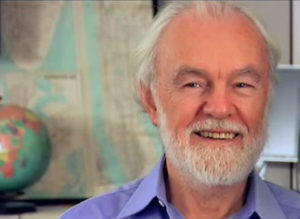
David R. Butler. Credit: Texas State University.

Our flagship journal, the Annals of the American Association of Geographers, begins the new year with a change of editorship for the newly named Physical Geography and Environmental Sciences section.

Mark A. Fonstad has completed two terms as editor of the Environmental Sciences section and is succeeded by David R. Butler, who assumes editorship of the Physical Geography and Environmental Sciences section.

David Butler is a Texas State University System Regents’ Professor in the Department of Geography at Texas State University. His accomplishments and experience spanning the discipline of geography are impressive, with research interests centering around geomorphology, biogeography, natural hazards, mountain environments and environmental change.

David has considerable editorial experience, including: serving as Section Editor for Geomorphology for the forthcoming AAG International Encyclopedia of Geography, as a section editor for the international journal Progress in Physical Geography, and as long-time book review editor for the journal Geomorphology. He has also guest edited/co-edited nine special issues of the journals Physical Geography, and Geomorphology. David is looking forward to leading the Physical Geography and Environmental Sciences section of the Annals: “It’s a tremendous honor to be selected to be editor of this section of the Annals, and I hope my many friends in physical geography will help out by submitting their best work for possible publication in the journal. Please put me to work!”

The AAG, the Publications Committee, and the rest of the Annals editorial team would like to express their heartfelt thanks to Mark Fonstad for his hard work over the last seven years. He has presided over a busy section, managing a heavy workload of manuscripts while ensuring that high quality and rigor were maintained.

The Annals of the AAG publishes six times a year (January, March, May, July, September and November) with one issue per year being a special themed issue. The upcoming March 2017 Special Issue is on the topic of Mountains. See the contents of the latest issue or browse all past issues. If you are interested in submitting a paper to the Annals, please refer to the information for authors.

    Share

David Harvey To Deliver Featured Lecture at AAG Annual Meeting in Boston

David Harvey, one of the most influential figures in geography and urban studies, and among the most cited intellectuals of all time across the humanities and social sciences, will deliver a featured lecture, “Marx, Capital and the Madness of Economic Reason,” on April 8, 2017, at the AAG annual meeting in Boston.
For geographers and non-geographers across many disciplines and languages, David Harvey has established the importance of space and uneven geographical development to the survival of capitalist accumulation, the perpetuation of inequality, and the rise of neoliberalism. His body of work demonstrates the highly creative and consequential place that geographers can have in engaging in and shaping broader transdisciplinary discussions and debates.

After receiving his Ph.D. from the University of Cambridge in 1961, Harvey’s research focused on social science trends using quantitative methods towards spatial science and philosophical theory. In the early 1970s, Harvey moved to Johns Hopkins University concentrating on radical and Marxist geography. At that time, injustice, racism, and exploitation were evident and activism around those issues was front-and-center, especially in Baltimore. In 2001, he became a distinguished professor at the City University of New York where he still resides.

His books, including Explanation in Geography, Social Justice and the City; Limits to Capital; The Condition of Postmodernity; Justice, Nature and the Geography of Difference; Spaces of Hope; The New Imperialism; A Brief History of Neoliberalism and The Enigma of Capital are some of the most widely-cited, best-selling and controversial writings across many disciplines. Harvey was also one of the first contributors to the journal Antipode.

Among his many international honors are his fellowships with the British Academy and the American Academy of Arts and Sciences. David Harvey will also receive the AAG Brunn Award for Creativity in Geography during the AAG awards luncheon on April 9, 2017. This annual AAG award recognizes a geographer who has demonstrated originality, creativity, and significant intellectual breakthroughs in geography.

    Share

Graduate Students Honored During AAG Regional Division Annual Fall Meetings for Outstanding Work

The American Association of Geographers (AAG) announces the recipients of the 2016 Council Award for Outstanding Graduate Student Paper at a Regional Meeting. Graduate student AAG members from around the U.S. participated by submitting to their region’s paper competition and attending their regional division fall meeting. A student paper from seven out of nine AAG regions was chosen by a jury of AAG regional division leaders and the honors for this inaugural award were given at each of the division meetings.

The award is designed to encourage graduate student participation at AAG regional division meetings and support their attendance at major AAG annual meetings. Each awardee will receive $1,000 in funding for use towards the awardee’s registration and travel costs to the AAG annual meeting.

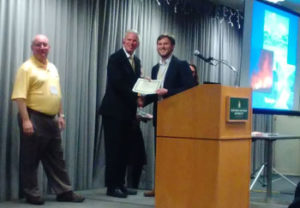
Jacob Watkins, recipient of the East Lakes (ELDAAG) division’s award, is a master’s student at Western Michigan University. The award was presented by AAG President Glen MacDonald and ELDAAG Regional Councillor Patrick Lawrence
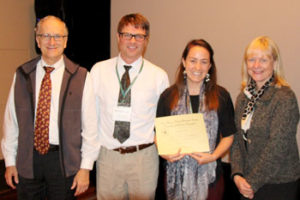
Kathleen Epstein, recipient of the Great Plains/Rocky Mountains (GPRM) division’s award, is a master’s student at Montana State University. Her paper is titled, “The multiple meanings of ecosystem management: A historical analysis of modern environmental conflict in the Greater Yellowstone.” Pictured from left to right are AAG Executive Director Doug Richardson, Vice President of GPRM Brandon J. Vogt, awardee Kathleen Epstein and AAG Past President Sarah Bednarz.


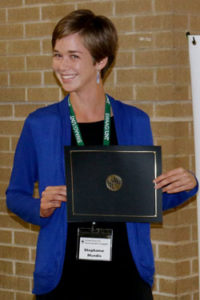
Stephanie Mundis, recipient of the Southwest (SWAAG) divisions’ award, is a master’s student at New Mexico State University. Her paper is titled “Spatial distribution of mosquitoes that vector Zika, dengue, and West Nile Virus in New Mexico” and included co-authors: Michaela Buenemann, Kathryn A. Hanley and Nathan Lopez-Brody.


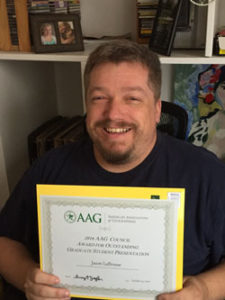
Jason LaBrosse, recipient of the West Lakes division’s award, is a master’s student at the University of Northeastern Illinois. His paper is titled, “The Relationship Between Concentrated Commodified Pets Populations and the Urban Environment of Chicago.”


Paul Miller, recipient of the Southeast division’s award, is a Ph.D. student at the University of Georgia.

Melody Lynch, recipient of the  New England\St. Lawrence Valley division’s award, is a master’s student at McGill University.

Ashley Marie Fent, recipient of the Pacific Coast division’s award, is a Ph.D. student at the University of California – Los Angeles.

The Middle States and Mid-Atlantic regional divisions did not issue an award in this category this year.

To find out more about submitting a paper for next year, visit aag council award for outstanding graduate student paper at a regional meeting

    Share

New Books: December 2016

Every month the AAG compiles a list of newly-published books in geography and related areas. Some are selected for review in the AAG Review of Books.

Publishers are welcome to send new volumes to the Editor-in-Chief (Kent Mathewson, Editor-in-Chief, AAG Review of BooksDepartment of Geography and Anthropology, Louisiana State University, Baton Rouge, LA 70803).

Anyone interested in reviewing these or other titles should also contact the Editor-in-Chief.

December 2016

America Observed: On an International Anthropology of the United States by Virginia Dominguez and Jasmin Habib (eds.) (Berghahn Books 2016)

Before Brasilia: Frontier Life in Central Brazil by Mary C. Karasch (University of New Mexico Press 2016 [2009])

Calculating Property Relations: Chicago’s Wartime Industrial Mobilization by Robert Lewis (University of Georgia Press 2016)

From Economic Zone to Eco-City? Urban Governance and Urban Development Trends in Tianjin’s Coastal Area by Iris Belle (Borntraeger Science Publishers 2015)

Maintenance Architecture by Hilary Sample (MIT Press 2016)

Marxist Thought and the City by Henri Lefebvre (author) and Robert Bononno (translator) (University of Minnesota Press 2016 [1972])

Mediated Geographies and Geographies of Media by Susan P. Mains, Julie Cupples, and Chris Lukinbeal (eds.) (Springer 2015)

Placing Names: Enriching and Integrating Gazetteers by Merrick Lex Berman, Ruth Mostern, and Humphrey Southall (eds.) (Indiana University Press 2016)

Spy Sites of Washington, DC: A Guide to the Capital Region’s Secret History by Robert Wallace and H. Keith Melton (Georgetown University Press 2017)

Sustaining Russia’s Arctic Cities: Resource Politics, Migration, and Climate Change by Robert W. Orttung (Berghahn Books 2017)

Teaching Climate Change in the Humanities by Stephen Siperstein, Shane Hall, and Stephanie LeMenager (eds.) (Routledge 2017)

Urban Centres in Asia and Latin America by Simone Sandholz (Springer 2017)

    Share

Nina Feldman: A Career in GIS and Geography

Nina Feldman, a former intern with AAG and the Geography and Map Division of the Library of Congress, shares why she chose a career in GIS and Geography in a very poignant guest blog post for Worlds Revealed: Geography & Maps at The Library Of Congress. She discusses the family members, professors and supervisors who inspired her and helped her to discover her love for GIS and Geography. Nina is currently a senior at George Washington University, majoring in Environmental Science and Geographic Information Systems (GIS).
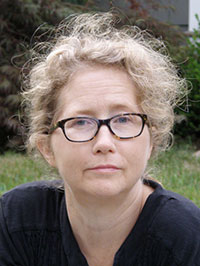
Read the full blog post: https://blogs.loc.gov/maps/2016/12/gis-day/

    Share

Jennifer Cassidento Appointed as AAG Publications Director

The American Association of Geographers is pleased to announce the appointment of Jennifer Cassidento as its new Publications Director.

Cassidento brings a wealth of editorial expertise and experience to the AAG publications. She has worked previously with major scholarly publishing houses, and for several years with the AAG on its journals, serving as managing editor of three of its flagship journals, including the Annals of the American Association of Geographers, the AAG Review of Books, and GeoHumanities. Jennifer also provided outstanding support and played a central role in the production of the forthcoming 15-volume AAG International Encyclopedia of Geography: People, the Earth, Environment, and Technology, which will be published in March of 2017.

In her role as AAG Publications Director, Jennifer will oversee all AAG publications, assisted by AAG staff as required, and will report directly to the AAG Executive Director, Douglas Richardson. In announcing her appointment, Richardson noted that “Jennifer Cassidento is one of the most talented, productive, and effective editors that I have ever encountered. We are pleased and honored to have her with us in this important leadership role at the AAG.”

    Share

New Books: November 2016

Every month the AAG compiles a list of newly-published books in geography and related areas. Some are selected for review in the AAG Review of Books.

Publishers are welcome to send new volumes to the Editor-in-Chief (Kent Mathewson, Editor-in-Chief, AAG Review of BooksDepartment of Geography and Anthropology, Louisiana State University, Baton Rouge, LA 70803).

Anyone interested in reviewing these or other titles should also contact the Editor-in-Chief.

December 2016

America Observed: On an International Anthropology of the United States by Virginia Dominguez and Jasmin Habib (eds.) (Berghahn Books 2016)

Before Brasilia: Frontier Life in Central Brazil by Mary C. Karasch (University of New Mexico Press 2016 [2009])

Calculating Property Relations: Chicago’s Wartime Industrial Mobilization by Robert Lewis (University of Georgia Press 2016)

From Economic Zone to Eco-City? Urban Governance and Urban Development Trends in Tianjin’s Coastal Area by Iris Belle (Borntraeger Science Publishers 2015)

Maintenance Architecture by Hilary Sample (MIT Press 2016)

Marxist Thought and the City by Henri Lefebvre (author) and Robert Bononno (translator) (University of Minnesota Press 2016 [1972])

Mediated Geographies and Geographies of Media by Susan P. Mains, Julie Cupples, and Chris Lukinbeal (eds.) (Springer 2015)

Placing Names: Enriching and Integrating Gazetteers by Merrick Lex Berman, Ruth Mostern, and Humphrey Southall (eds.) (Indiana University Press 2016)

Spy Sites of Washington, DC: A Guide to the Capital Region’s Secret History by Robert Wallace and H. Keith Melton (Georgetown University Press 2017)

Sustaining Russia’s Arctic Cities: Resource Politics, Migration, and Climate Change by Robert W. Orttung (Berghahn Books 2017)

Teaching Climate Change in the Humanities by Stephen Siperstein, Shane Hall, and Stephanie LeMenager (eds.) (Routledge 2017)

Urban Centres in Asia and Latin America by Simone Sandholz (Springer 2017)

    Share

AAG Unveils New Disciplinary Data Dashboard

The AAG receives numerous requests for data related to geography and geographers. Often such requests come from members who are doing research on the discipline, or who are interested in knowing, for example, the proportion of women who hold the rank of associate professor or the average value of a graduate student assistantship.

Academic departments also frequently contact the AAG seeking data that will inform a program review, support an application to establish a new degree program, or help them make a case to prospective majors interested in career opportunities in geography. It is also common for the AAG to receive inquiries from journalists and the general public about the status of geographic literacy in K-12 schools or enrollment trends in higher education.

The AAG has been able to respond to these many requests for data thanks to its multiple ongoing data collection efforts involving members, departments, and special research surveys. Over the past decade this work has generated a considerable amount of data and content across the entire AAG website.

In an effort to consolidate and facilitate access to all of the disciplinary data collected by the AAG, a new AAG Disciplinary Data Dashboard was created on the AAG website at www.aag.org/disciplinarydata.

The Dashboard provides access to a diverse array of AAG-collected disciplinary data on gender and diversity, academic departments, geography careers, and AAG Annual Meetings, as well as archival information and materials available in the AAG Archives held at the Library of Congress. All of the data is searchable by source or by theme (e.g., geography in schools, gender, race and ethnicity, etc.).

In addition to raw data collected from AAG membership forms, academic department surveys, and other AAG research projects, the Dashboard includes original analytical reports featuring narrative summaries and data visualizations that provide quick overviews of major trends and patterns. Additional reports are currently being prepared by AAG staff and will be posted to the Dashboard in the coming months.

Visitors to the Dashboard will also find links to many third-party sources of disciplinary data produced by external organizations, as well as updated lists of journal articles and other research publications about geography as a discipline.

The AAG invites all members to explore the AAG Disciplinary Data Dashboard. We welcome your comments and suggestions at data [at] aag [dot] org.

    Share

NSF to Host Webinar on Smart & Connected Communities Solicitation

The National Science Foundation would like to make the geography and spatial science communities aware of the Smart and Connected Communities (S&CC) solicitation (NSF 16-610).  The competition expects a significant social and behavioral component to be contained in the proposals and will likely be of interest to many geographers.

There will be a webinar about this new S&CC solicitation on October 20, 2016 from 2:30 to 3:30 pm eastern time.  The direct link to the event page for the S&CC webinar is as follows:  https://www.nsf.gov/events/event_summ.jsp?cntn_id=190025&org=CISE.  It is currently on the CISE homepage under Popular links, Webcasts/Webinars.

Some key components of the solicitation:

Due Dates

  • Preliminary Proposal Due Date(s) (required) (due by 5 p.m. submitter’s local time): November 30, 2016
  • Full Proposal Deadline(s) (due by 5 p.m. submitter’s local time): February 16, 2017

Proposal Categories

This S&CC solicitation will support research projects in four categories:

  • S&CC Integrative Research Grants (IRGs) Track 1. Awards in this category will support the conduct of fundamental, multidisciplinary, integrative research and the building of research capacity. Track 1 awards will provide three to five years of support for projects at a level not to exceed $5,000,000 for the total budget.
  • S&CC Integrative Research Grants Track 2. Awards in this category will support the conduct of fundamental, multidisciplinary, integrative research and the building of research capacity. Track 2 awards will provide three or four years of support for projects at a level not to exceed $1,000,000 for the total budget. It is anticipated that Track 1 and 2 proposals will be distinguished by the sizes of the teams, as well as, the scope and duration of the proposed activities.
  • S&CC Research Coordination Networks (RCNs). Awards in this category support the establishment of a network of multidisciplinary researchers and others who will collectively and significantly advance S&CC research through active exchange of ideas, development of fundamental research directions, and other approaches. Each of these awards will provide four or five years of support for projects at a level not to exceed $500,000 for the total budget.
  • S&CC Planning Grants. Awards in this category will provide one year of support to stimulate research capacity through multidisciplinary team-building and the development of high-impact, fundamental research concepts. Each of these awards will be at a level not to exceed $100,000 for the total budget.

Limit on Number of Proposals per PI or Co-PI: 4

The limit on number of proposals per PI, Co-PI, or other Senior Personnel is defined by award category as follows:

  • Integrative Research Grants Track 1 or Track 2: 1;
  • Research Coordination Networks: 2; and
  • Planning Grants: 1.

An individual may appear as a PI, Co-PI, or other Senior Personnel on only one proposal submitted to either S&CC IRG Track 1 or Track 2 (not both), only two proposals submitted to the S&CC RCN category, and only one proposal submitted to S&CC Planning Grant category. This limitation includes proposals submitted by a lead organization and any sub-awards included as part of a collaborative proposal involving multiple institutions.

Preliminary proposals are required only for S&CC Integrative Research Grants (IRG) Tracks 1 and 2 and must be submitted in accordance with the instructions below. The NSF decision made on the preliminary proposal is advisory only and may include feedback on proposed activities, including anticipated budgets. Submission of a Preliminary Proposal is required in order to be eligible to submit a Full S&CC IRG Proposal.

Please refer to the solicitation for further details.  For questions about the solicitation please contact Sunil Narumalani, a program director in the Geography & Spatial Sciences Program and also a managing program director for this new opportunity, snarumal [at] nsf [dot] gov.

    Share