Newsletter – January 2021

PRESIDENT’S COLUMN

Advocate for Geography in Austerity Part 2

By Amy Lobben
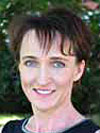
This is Part 2 of a two-part column I started last month on what geography departments can do (and should not do) to advocate for their work in budget talks, which are all the more crucial during the COVID-19 pandemic.

Last month, I focused on what Geography Departments should not do. This month, I summarize some of the strategies departments should pursue to remain relevant to students, the public, and university and college administration.

Continue Reading.

FROM THE MERIDIAN

Getting Our Bearings in Washington, D.C. and Charting Our Future

By Gary Langham

The insurrection at the United States Capitol on January 6th was equal parts terrifying and disorienting. As always, during a crisis, it takes time for the full story to emerge, but a few things are clear now: words and principles matter, and unity can only occur after accountability. These events heighten our appreciation of the delicate nature of democracy and the critical role of a well-informed populace.

Washington, D.C. is a city full of meaning, down to the symbolic layout of its streets… This April, the AAG will mark its 50th anniversary in our headquarters housed along 16th Street NW, aptly named Meridian Place, a fundamental part of the cartographic and symbolic centering of Washington, D.C.

Continue Reading.

ANNUAL MEETING

Land, Space, and the Ocean: Honorary Geographer Kathryn Sullivan to speak at AAG 2021

Geologist, astronaut, and award-winning NOAA scientist Kathryn Dwyer Sullivan is one of the most versatile of scholars, with a career that has quite literally run the gamut from space to the deep blue sea. Hear 2020’s AAG Honorary Geographer speak in a special keynote at AAG 2021.

Last year, the AAG Executive Committee recognized Sullivan’s distinguished career, including being the first American woman to walk in space, as well as serving as Under Secretary of Commerce for Oceans and Atmosphere, and as a NOAA Administrator. Sullivan steered priority work in the areas of weather and water services, climate science, integrated mapping services and Earth-observing capabilities. Sullivan also led NOAA’s efforts with regard to satellites, space weather, water, and ocean observations and forecasts to best serve American communities and businesses. As a woman scientist and role model, Kathryn Sullivan mirrors many of the values the AAG also actively pursues in our discipline and our association.

Read here about Sullivan’s amazing 2020 journey to the bottom of the ocean–the first woman ever to have done so.

AAG 2021 Goes Virtual – Poster Deadline January 29
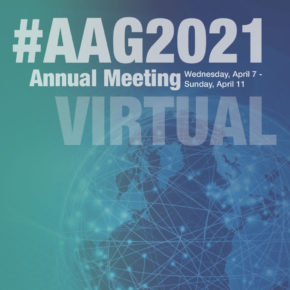
 

In mid-November, AAG made the difficult but necessary decision to shift the 2021 annual meeting to a completely virtual experience. A streamlined process is in place to help session and activity organizers bring their programming to the virtual environment, with the assistance of AAG staff. The shift to virtual does not affect any of our existing deadlines for registration, submissions, or session organizing including the upcoming poster abstract deadline on January 29.


PUBLICATIONS

NEW GeoHumanities Issue Alert: Articles with topics ranging from therapeutic landscapes to zine-making to the Great Barrier Reef

MThe most recent issue of GeoHumanities has been published online (Volume 6, Issue 2, December 2020) with 14 new research articles and creative pieces on subjects within geography. Topics in this issue include ghost citiessocial movementsU.S. National Parkshistorical geographies of adoption and abortioncreative map making; and archival spaces. Articles also explore mediums such as photographythe color bluepersonal essays; and language translation. Authors are from a variety of research institutions including the London School of EconomicsMcMaster UniversityUniversity of Texas at Austin; and University of Wollongong.

All AAG members have full online access to all issues of GeoHumanities through the Members Only page. In every issue, the editors choose one article to make freely available. In this issue you can read Imagining Environmental Justice “Across the Street”: Zine-making as Creative Feminist Geographic Method by Gabriella Velasco, Caroline Faria & Jayme Walenta for free.

Questions about GeoHumanities? Contact geohumanities [at] aag [dot] org.

NEW Annals Alert: Articles with topics ranging from historic wilderness management to women’s food businesses, from bioenergy systems to light pollution

The most recent issue of the Annals of the AAG has been published online (Volume 111, Issue 1, January 2021) with 18 new articles on contemporary geographic research. Topics in this issue include geographical imagination systemsthe World Bankdesertsabnormal embryosozone exposuregerrymanderingmapping inequality; and flood risk. Locational areas of interest include Tucson, Arizonanorthern MinnesotaJordanrural Franceupland Laos; and coastal Louisiana. Authors are from a variety of research institutions including China University of GeosciencesUniversity of BristolUniversity of Florida; and University of Central Florida.

All AAG members have full online access to all issues of the Annals through the Members Only page. Each issue, the Editors choose one article to make freely available. In this issue you can read More than Metaphor: Settler Colonialism, Frontier Logic, and the Continuities of Racialized Dispossession in a Southwest U.S. City by Sarah Launius & Geoffrey Alan Boyce for free for the next two months.

Questions about the Annals? Contact annals [at] aag [dot] org.
In addition to the most recently published journal, read the latest issue of the other AAG journals online:

• Annals of the American Association of Geographers
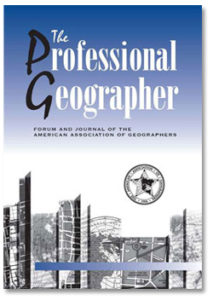
• The Professional Geographer
• GeoHumanities
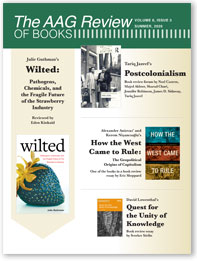
• The AAG Review of Books

Call for Abstracts: Special Issue of ‘Annals’ on “Race, Nature, and the Environment”
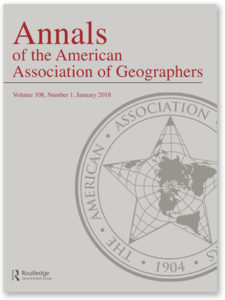
The 2023 Special Issue of the Annals invites new and emerging geographic scholarship situated at the crossroads of Race, Nature, and the Environment. In seeking contributions from across the discipline, we welcome submissions that advance critical geographic thinking about race and the environment from diverse perspectives and locations; that utilize a broad array of geographic data, theories, and methods; and that cultivate geographic insights that cut across time, place, and space. Abstracts of no more than 250 words should be submitted by e-mail to Jennifer Cassidento by March 31, 2021. The Editor (Katie Meehan) will consider all abstracts and then invite a selection to submit full papers for peer review by June 1, 2021.

More information about the special issue.


ASSOCIATION NEWS

AAG is Proud to Announce the 2021 AAG Honors

 

awardsSince 1951, AAG Honors have been offered annually to recognize outstanding accomplishments by members in research and scholarship, teaching, education, service to the discipline, public service outside academe, and for lifetime achievement. Each year, the AAG invites nominations for AAG Honors to be conferred in recognition of outstanding contributions to the advancement or welfare of the profession. The AAG Honors Committee is charged with making award recommendations for each category, with no more than two awards given in any one category. The AAG is proud to officially announce the 2021 AAG Honors.

See the Honorees.

AAG Announces Diversity & Inclusion, Mentoring, & Undergraduate Awards

honors and awards

The American Association of Geographers congratulates the individuals and entities named to receive an AAG Award. The 2021 Diversity and Inclusion Award is presented to Raynah Kamau and Whitney Kotlewski of Esri as well as to Jovan Lewis from University of California at Berkeley. Hilda Kurtz from University of Georgia has received the 2021 Susan Hardwick Excellence in Mentoring Award. The 2021 Marble-Boyle Undergraduate Achievement Award in Geographic Science is awarded to Jessica Embury of San Diego State University and Daniel Council of Ball State University.

See the Awardees.

AAG Thanks 2020 Donors for their Support

Thank you to the 479 donors who made 510 donations during 2020 totaling $148,155. Your donations provided resources to over 20 different funds. Here are some of the highlights:

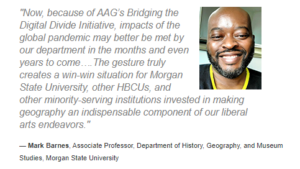
60 members made gifts totaling $8,629 to support the Bridging the Digital Divide Fund. These funds were supplemented by a gift from Esri for $50,000 and will allow AAG to further its work with Tribal and Historically Black colleges and universities, and other minority-serving institutions. The COVID-19 pandemic exposed how crucial it is for students to connect remotely to classrooms and mentors. Geography students at minority serving institutions have been particularly affected by the technology gap. AAG launched Bridging the Digital Divide as part of its COVID-19 rapid response and allotted $238,000 of internal funds that supported students at 23 institutions for the fall 2020 semester.

The COVID-19 Rapid Response Fund received donations from 38 members totaling $6,462 that helped AAG launch nine projects to help the geography community during the pandemic. The AAG Council approved spending nearly $1 million of reserves to initiate projects such as Bridging the Digital Divide, two webinar series to advance members ‘ professional development and help students with their research, a mentoring program, support for the divisions, and renewal dues assistance.

318 members and friends donated a portion or all of their annual meeting registration fees when the 2020 and 2021 annual meetings went virtual. These contributions totaled $35,041.50.

The Black Geographies Specialty Group raised $4,256 from 33 members and other specialty groups received 12 donations totaling $2,245.

Unrestricted gifts were also received from 15 members totaling $3,930. During these uncertain times, these gifts provide AAG with the greatest amount of flexibility to help strengthen academic geography, enhance diversity in the discipline, offer leadership training, workshops and forums, and grow the field.

Several of AAG’s awards, prizes and scholarship funds continued to receive strong support that totaled $29,350 including a $20,500 for the Marble Fund, $6,000 to the Hess Scholarship Fund, $1,350 to the Marcus Fund, $1,000 for the Stanley Brunn Award, and $500 to the Wilbanks Award.

2021 AAG Election Underway

The AAG election will be conducted online again, and voting will take place January 7-28, 2021. Each member who has an email address on record with the AAG will receive a special email with a code that will allow them to sign in to our AAG SimplyVoting website and vote. It’s important to update your email address in your AAG account to ensure you receive the email ballot.

Read about the 2021 candidates.

AAG Holds Workshops on Public Scholarship at Virtual Regional Division Meetings

Geography and the AAG depend on you to increase visibility of geographers’ work. In response to the growing need and opportunity for geographers to enter into public scholarship, AAG developed a workshop for geographers at all stages of their careers to share their research and perspectives across different forms of media. Titled “Getting the Word Out about Geography,” the workshop was led by AAG staff at five AAG Regional Division meetings held virtually this fall.

Learn more about the workshop.


POLICY CORNER

Call to Action: Get Involved in 2021 Redistricting
 

Image-118 capitol buildingAfter a decade with our current legislative district maps, the time for 2021 state and congressional redistricting has finally arrived. If you’ve ever cared about gerrymandering and wanted to exercise your power as a geographer to make a difference, finding statewide opportunities for public participation this year should be your next step. As a service to both your community of geography colleagues, and to the community in which you live, it’s up to you to secure your place in the process, offer your best input, and help hold officials accountable.

Anyone with strong geospatial understanding has a lot to contribute to the redistricting process. It’s a perspective that redistricting officials sorely need, but often lack. And you do not have to be a GIS expert to contribute – as a geographer, you deserve to be at the table.

If you have as little as 15 minutes, you can make an impact. The AAG has compiled the following guide on Four Ways to Make an Impact on Gerrymandering and Redistricting.

In the News:

  • Following last week’s violent riots at the U.S. Capitol, the House on Wednesday voted to impeach President Trump. He is the only U.S. President to have been impeached twice. The process will move to the Senate where outcomes currently remain uncertain.
  • With Democratic candidates winning the two Senate runoff races in Georgia earlier this month, Chuck Schumer will be the new Senate Majority Leader and Democrats will take control of all Senate committees.
  • President-elect Biden plans to unveil his additional Covid relief proposal Thursday. It will likely include boosting direct payments to individuals from $600 to $2,000 and is also expected to include more financial aid for state and local governments, additional unemployment benefits, funds to improve vaccine distribution, continued forbearance for rent payments, and aid for small businesses.

MEMBER NEWS

January Member Updates

The latest news about AAG Members.

AAG member Anthony Bebbington has been named The Ford Foundation’s new International Director of its Natural Resources and Climate Change program, leading the team that oversees Ford’s global work supporting rural, low-income, Indigenous, traditional, and Afrodescendant communities in the Global South who play a key role in mitigating climate change, improving governance over natural resources, and securing land rights for their people. Bebbington joins Ford Foundation after serving as the Milton P. and Alice C. Higgins Professor of Environment and Society in Clark University’s Graduate School of Geography. A member of the board of directors at Oxfam America and internationally recognized leader and scholar on extractive industries and natural resource governance, Bebbington brings more than 35 years of experience working with Indigenous and rural communities, civil society, the private sector, and policymakers.

Bebbington was Director of the Graduate School of Geography at Clark University from 2010 to 2017, and was elected to the National Academy of Sciences in 2009 and the American Academy of Arts and Sciences in 2014. He received a Distinguished Scholarship Honors award from AAG and a fellowship from the Guggenheim Foundation, among other accolades. More.

Collins the First Geographer in ELATES Leadership Program for Women Scientists

Jennifer CollinsUniversity of South Florida geography professor Jennifer Collins is among thirty women scientists–and the first geographer–to take part in this year’s ELATES program at Drexel University. This national leadership development program is designed to advance the careers of senior women faculty in academic STEM disciplines. After some delay for the in-person training due to COVID-19, Collins will begin the intensive, full-year, part-time fellowship program later this year.

“I am looking forward to completing the program in the next year,” says Collins, who teaches in the School of Geosciences and whose research focuses on weather and climate, specifically hurricanes and interaction between large-scale climatic patterns and seasonal patterns of tropical cyclone activity. She says she is especially enthusiastic about the ways that ELATES can strengthen her teaching and mentoring. “When I entered a faculty position, I had experience with research with my PhD but we had no training on how to teach back then. We were just thrown in and learnt by trial and error. Similarly, with leadership, there are few training opportunities. I have had a lot of leadership roles, particularly in my professions, but I am particularly excited for the opportunity ELATES offers me to have discussions on leadership that I have not had before, opening me up to new perspectives, skills, and knowledge, and a life-long network of inspiring female leaders.”

The application for the next ELATES cohort is January 31, 2021. Find out more here.


RESOURCES AND OPPORTUNITIES

Early Career and Department Leadership Webinar Series Continues in 2021

Last fall, the AAG piloted a new webinar series as a service to AAG members and the wider geography community. The series focused on topics of interest to students and early career geographers, as well as department leadership issues, especially those involving building and growing strong academic programs at the undergraduate and graduate levels. The AAG is pleased to announce the continuation of the webinar series in 2021, resuming in late January and continuing through the spring.The first webinar, Building a Strong Professional Network – A Research Approach, is scheduled for Wednesday, January 27 at 3pm EDT. Registration is free and now open and URLs for the new series will be announced as soon as they are available.

For more information on the webinar series, visit: http://www.aag.org/careerwebinars.

Events Exploring Entrepreneurship and Immigration at the Kauffman Foundation


The Kauffman Foundation is pleased to announce two virtual events in January. The January Entrepreneurship Issue Forum, “Immigration and Entrepreneurship: Knowledge Landscape,” will take place at 9 a.m. CST / 10 a.m. EST on Thursday, January 28. It will focus on what is known about immigration and entrepreneurs, including the economic effects of immigrant entrepreneurs, pathways and implications of entrepreneurship for immigrants, and a discussion of policy and programmatic action among and by practitioners. Register here.

The Early-stage Researcher Professional Development Series will take place at 1 p.m. CST on Friday, January 29 with mentors Rob Seamans (New York University) and Michelle Budig (University of Massachusetts Amherst). This series is open to 15 early-stage researchers to connect with research mentors to discuss research approaches, professional development and the research career trajectory. Register for the Professional Development Series here.

Career Mentors Needed for 2021 AAG Virtual Meeting
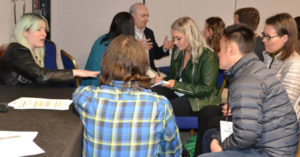
The AAG seeks professional geographers representing the business, government, nonprofit and academic sectors to serve as volunteer “Career Mentors” during the 2021 AAG Virtual Meeting. Career mentoring provides an open forum for students and job seekers to receive one-on-one and small-group consultation about careers in a variety of industries and employment sectors. Mentors are expected to answer questions and provide general career advice to students and job seekers interested in learning more about industries that employ geographers, the work geographers perform and strategies for getting into the field. This year we will be organizing eight sessions, one each morning and one each afternoon of the conference, to provide our virtual attendees around the world with more opportunities to participate.

For additional questions and to volunteer, please contact Mark Revell at the AAG at mrevell [at] aag [dot] org by March 1st, 2021.

The 34th Congress of the International Geographical Union

IGU logoThe 34th Congress of the International Geographical Union was postponed from August 2020 to August 2021 due to the covid-19 pandemic. The Congress will be held in Istanbul, Turkey, August 16-20, 2021.

Details are available at https://www.igc2020.org/en/.


IN MEMORIAM

The AAG is saddened to hear of the passing of these colleagues.

Barry Lopez, the 2011 AAG Honorary Geographer, passed away at the age of 75 on December 25, 2020 after battling prostate cancer. Lopez, who spoke during the 2011 AAG Annual Meeting in Seattle, WA, was recognized for his evocative portrayals of people living in close communication with nature, and for his exemplary works of fiction and nonfiction alike that honor and inspire ideas about geography and landscape. Read more.
Lynn StaeheliLynn Staeheli, a professor and former head of the School of Geography and Regional Development at the University of Arizona, passed away December 20, 2020 at her home in Tucson, AZ. Professor Staeheli’s research focused on what she called the “big, contentious topics” such as the nature and spatial dimensions of democracy, citizenship, and politics.  More concretely, her research topics included publicly accessible space, protest and activism, immigration and refugees, and the role of faith, religion, and spirituality in public life. Read more.

Curtis C. Roseman, professor emeritus of geography at University of Southern California-Dornsife, died on December 13, 2020. He was a professor in the Department of Geography at the University of Southern California from 1985 to 2004, serving as Department Chair from 1985 to 1992. Among the many honors and awards he received over the years were the USC Community Service Award, the USC Faculty Volunteer Good Neighbor Award, Distinguished Scholar Award from the Ethnic Geography Specialty Group of the American Association of American Geographers, and a 1989 Fulbright Fellowship to New Zealand. Read more.

William Dando, 50 year AAG member and longtime chair of the Bible Geography specialty group, passed away on January 1, 2021. A full written tribute is forthcoming.

Moshe Brawer (משה ברוור‎‎) died on 28 December 2020. He was 101. Considered “the Father of Israeli geography,” he was the author of The Atlas of the World, an Israeli textbook published in 67 editions. He also compiled 20 other atlases in different languages. In 2002, he won the Israel Prize in geography. Among his accomplishments was determining the border of Israel with Jordan. He “was a man of great stature,” Brawer’s daughter, Orit Brawer Ben David, said. He is survived by his wife, Rina, 91, four children and eight grandchildren.


GEOGRAPHERS IN THE NEWS
  • AAG member Alexander Reid Ross tracked 770 incidents of extremist, racist violence in 2020. As overall incidents declined, Ross told CityLab in October that attacks were growing more severe: “I think there will be more plans for targeted bombings, kidnappings, & assassinations.”
  • How to Lie with Maps by Mark Monmonier was featured on 8 essential books for geographers list from Geographical.

EVENTS CALENDAR

Submit News to the AAG Newsletter. To share your news, email us!
    Share

Newsletter – December 2020

PRESIDENT’S COLUMN

Advocate for Geography in Austerity

By Amy Lobben

Better_Days_Ahead_IanTaylor_Unsplash-300x169-1This month I will begin a two-part column on what geography departments can do (and should not do) to advocate for their work in budget talks, which are all the more crucial during the COVID-19 pandemic. These points are largely derived from answers I received from geographers in upper administrative positions at universities.
If 2020 has taught us nothing else, it is that geography is a crucial discipline for grasping and addressing the dire issues our earth faces. Yet in a year that has demonstrated our value, some of our geography departments continue to struggle for relevancy of university campuses.

Continue Reading.

ANNUAL MEETING

AAG Annual Meeting Goes Virtual for 2021

AM2021V-1000X1000sq-290x290-1

In mid-November, AAG made the difficult but necessary decision to shift the 2021 annual meeting to a completely virtual experience. While we are encouraged by recent news of breakthrough treatment and prevention options for COVID-19, the pandemic’s current trajectory indicates that it won’t be fully resolved by April. A streamlined process is in place to help session and activity organizers bring their programming to the virtual environment, with the assistance of AAG staff. The shift to virtual does not affect any of our existing deadlines for registration, submissions, or session organizing. We want to thank you for being part of the AAG community. Your presence and support mean the world to us.

PUBLICATIONS

Journals-newsletter-100-1Read the latest issues of all of the AAG journals online:

• Annals of the American Association of Geographers
• The Professional Geographer
• GeoHumanities
• The AAG Review of Books

New issue of African Geographical Review

African-Geographical-Review-cvr-212x300-1The latest issue of the journal of the Africa Specialty Group of the AAG, the African Geographical Review, has recently been published. Volume 39, Issue 4 (December 2020) is available online for subscribers and members of the Africa Specialty Group. The latest issue contains six articles covering all sub-fields of geography and one article commentary, to enhance the standing of African regional geography, and to promote a better representation of African scholarship.
See more about the journal.

ASSOCIATION NEWS

Thank you for your support of the Bridging the Digital Divide Fund

BDD_testamony-300x169-1Our thanks to members and supporters who made gifts on Giving Tuesday, December 1st, to AAG’s Bridging the Digital Divide Fund. We received 37 donations, and hope to reach 100 by the end of the month.
Bridging the Digital Divide addresses the technology gap that affects too many students–particularly those who are enrolled at minority-serving institutions–who cannot afford personal computers, software, and internet access. The pandemic interfered with the education of many geography students at minority-serving institutions, affecting their ability to complete or even enroll in classes, and causing them to postpone their education as they were unable to connect remotely to the classroom.

Right now, AAG is working with faculty at eight Tribal Colleges and Universities, fourteen Historically Black Colleges and Universities, and one predominantly Black institution to close the technology gap. AAG has provided funds for these geography programs to purchase laptops, software, and internet connections for their students. More than 200 geography students benefited this semester, and we hope to expand the program.

The digital divide existed before COVID-19 and will not go away even as solutions to the pandemic begin to emerge. There’s still time to make a gift. Our collective action will help to leverage industry and foundation partners. No matter the size of your gift, it will make a difference.

Give Now to Bridging the Digital Divide.

Congratulations to Outstanding Graduate Student Papers from Regional Meetings

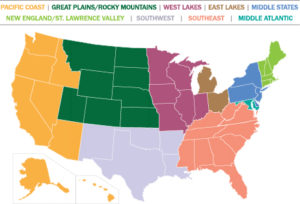
Regional_Divisions_interactive_map467-300x204-1The AAG is proud to announce the Fall 2020 student winners of the AAG Council Award for Outstanding Graduate Student Paper at a Regional Meeting. The annual award, designed to both encourage regional meeting participation and support AAG Annual Meeting attendance, is granted to one student from each division as decided by regional division board members. The winners from each region will present their work in two dedicated sessions at the 2021 AAG Annual Meeting. Congratulations to all of the students who participated!

Read more about the recipients.

Call for Proposals: AAG Learning Series on Graduate Research Methods in COVID-19

Geography-Methods-during-a-Pandemic-flipped-300x124-1AAG has issued a new call for proposals, seeking instructors and graduate assistants for its  Learning Series for Graduate Students this spring. To support graduate students in adapting in their research during COVID-19, AAG seeks instructors at all levels and in all sectors (professionals  lecturers, and faculty from early to advanced career) to develop virtual seminars or workshops.

For workshops and seminars developed by one instructor, AAG will pay the instructor $1,500, and for those developed by more than one instructor, AAG will pay $1,000 per instructor. Proposals with multiple instructors must include clearly defined roles and responsibilities. AAG is also offering a $100 stipend for up to four graduate students to assist instructor(s) during interactive sessions. If selected, the instructor(s) will be able to pick a week between March and June 2021 during which they will offer the seminar or workshop.

The deadline to apply is on or before Thursday, January 14, 2021. See more details and apply here.

Get ready for the 2021 AAG Election

Election-button-1

The AAG election will be conducted online again, and voting will take place January 7-28, 2021. Each member who has an email address on record with the AAG will receive a special email with a code that will allow them to sign in to our AAG SimplyVoting website and vote. It’s important to update your email address in your AAG account to ensure you receive the email ballot. The 2021 election slate will be published soon.

Be prepared for the election.

POLICY CORNER

2021 Redistricting: How Geographers Can Get Involved

US_Capitol-2

The U.S. Census Bureau is quickly approaching their Dec. 31st deadline to report all population counts in order for states to proceed with the 2021 redistricting process. Due to complications and some irregularities revealed from the 2020 Census, however, the bureau runs a real risk of missing that deadline. These “processing anomalies” have shown some major inconsistencies that could take weeks to rectify. But once disclosed, the state population reports signify the kickoff of next year’s nationwide redistricting.

Geographers have been conducting extensive work on gerrymandering and the redistricting process for years. While these researchers demonstrate great expertise and experience, it is clear that anyone with strong geospatial understanding has something to contribute to the redistricting process. It’s a perspective that redistricting officials sorely need, but often lack. And you do not have to be a GIS expert to get involved.

If you have as little as 15 minutes, you can make an impact. The AAG has compiled the following guide on Four Ways You Can Make an Impact on Gerrymandering and Redistricting.

In the News:

  • Congress is voting to extend government funding at current FY20 levels to avert a government shutdown Friday. The extension will last only one week with the goal of finalizing FY21 appropriations before adjourning for the holiday recess. 
  • Negotiations continue for a COVID relief package that both parties can agree on. A bipartisan group of Senators is working on a compromise bill that comes in at $908 billion. If a deal can be reached, it will be considered as part of the FY21 appropriations package.
  • NSF is inviting proposals for new SBE-led initiatives on strengthening infrastructure, broadening participation in entrepreneurship, and enhancing social science capacity at minority-serving institutions.
MEMBER NEWS

Profiles of Professional Geographers

Trang_VoPham_crop2_1-225x300-1

In her position as an Assistant Professor of Epidemiology in the Epidemiology Program, Division of Public Health Sciences, at Fred Hutchinson Cancer Research Center, Trang VoPham investigates environmental risk factors for cancer using geospatial methods to understand how place or location might impact health. VoPham has seen a recent emphasis on geospatial science in jobs advertisements for cancer centers, a sign that geospatial skills can be “highly valuable and useful in careers related to epidemiology and environmental health.”

Learn more about Geography Careers on the recently updated AAG Jobs & Careers website.

December Member Updates

The latest news about AAG Members.

Guo Chen (Michigan State University) received an Outstanding Service Award from AAG-China Geography Specialty Group. This award is presented to the individuals who provided significant services to the China Geography Specialty Group or made important contributions to the advancement of China geography studies.

The China Geography Specialty Group also presented the Student Paper Award to Ronghao Jiang (Hong Kong University), and two Student Travel Awards to Samuel Kay (Ohio State University) and Jiang Chang (Michigan State University). These student awards recognize excellent student papers presented in CGSG-sponsored sessions at the AAG annual meeting, and testify to the hard work invested by students, mentors and institutions supporting them, to generate outstanding research.

RESOURCES AND OPPORTUNITIES

Free Access: 49 Articles on Black Geographies and Racial Justice

In response to the call for more open access to vital scholarship on anti-Blackness and racism, issued by the Black Geographies Specialty Group last June and supported by 37 other AAG Specialty and Affinity Groups in their own letters, AAG and Taylor & Francis are providing free access to 49 articles from our journals through December 31, 2020. AAG acknowledges that this is but one action we must take toward creating a more representative discipline that fully responds to the urgency of confronting and defeating systemic racism, within our discipline and in society at large.

See the articles.

End of Year Deadlines for Grants and Awards, Students and Professionals

awards_hi-res-300x160-1

As the calendar year comes to a close, several deadlines for grants and awards are approaching. December 31st marks the deadline for multiple student awards such as the AAG Dissertation Research Grants  or the Hess Community College Geography Scholarship. Students and professionals are invited to apply for fieldwork related awards through either an AAG Research Grant or the Anne White Fund, both also due on December 31st. Nominations are currently being solicited for a variety of books in geography awards including the Globe Book Award, the Jackson Prize, and the Meridian Book Award, all of which are due on December 31st. Members may also nominate their colleagues for the Glenda Laws Award for social justice and the Harold M. Rose Award for anti-racism research and practice as well as the AAG Wilbanks Prize for Transformational Research in Geography. For colleagues who have made contributions to geography in teaching, consider nominations to the Harm J. de Blij Award for Excellence in Undergraduate Geography Teaching or the AAG E. Willard and Ruby S. Miller Award, both also due December 31st.

See all grants and awards deadlines.

Call for Submissions for you are here

you-are-here-290x290-1

you are here: the journal of creative geography is now accepting submissions for the 2021 issue: bodies & politics. This issue will focus on the significance and political potentials of bodies and embodiment in the current political moment. Please see the full call for submissions on the you are here website. you are here is an annual publication produced by graduate students at the University of Arizona School of Geography, Development, and Environment. The journal seeks to explore geographic themes through poetry, creative writing, maps, photographs, visual art, sonic art, film, and other imaginable genres. you are here encourages submissions from geographers, historians, anthropologists, architects, scientists, writers, artists, activists and anyone else interested in exploring creative geography.

Submissions are due January 12, 2021, by the end of the day. For details of submission guidelines and process, visit the website.

December Kauffman Foundation Early-stage Researcher Professional Development Series

Kauffmann-300x110-1

The next virtual Early-Stage Research Professional Development session will take place 1 p.m. CST December 11, 2020 with mentors Jason P. Brown, a Research and Policy Officer in the Economic Research Department of the Federal Reserve Bank of Kansas City and Peter G. Klein, W. W. Caruth Endowed Chair, Professor of Entrepreneurship, and Chair of the Department of Entrepreneurship and Corporate Innovation at Baylor University Hankamer School of Business. This series is open to 15 early-stage researchers to connect with research mentors to discuss research approaches, professional development and the research career trajectory.

Register here for the December session.

IN MEMORIAM

The AAG is saddened to hear of the passing of these colleagues.

Alex Trebek, the Jeopardy! host, passed away on November 8, 2020 at the age of 80 surrounded by family and friends. The broadcaster turned game show host was endeared by millions. Trebek was a lifelong lover of geography and hosted the National Geographic Bee for 25 years from 1989 to 2013. He championed for geographic education and encouraged students to be knowledgeable on the world around them.

Jan Morris, the Welsh historian and travel writer died November 20, 2020 at the age of 94. Morris wrote extensively about history, the details of place, and her life as a transgender woman. Morris covered the first ascent of Mount Everest with Edmund Hillary in 1953 and continued to write about some of the most important moments in history. Her work reinvented travel writing and her book, Conundrum discusses transexuality and opened doors to pioneering gender geographies.

FEATURED ARTICLES

The Advancement of Location Analytics in Business Schools

By Joseph Kerski

insurance-300x126-1

A quiet geographic revolution is occurring on many university and college campuses around the world. Faculty and students in schools and colleges of business are increasingly turning to GIS tools and data in instruction and research. Given that business has always been about “location, location, location,” it makes sense that educators seeking to prepare their students for the workplace are doing so. Yet location analytics, as it is most often called in business schools, took some years to gain a firm foothold. Why is this the case, what are the implications, and how can the geography community assist with these exciting developments?

Continue reading.

GEOGRAPHERS IN THE NEWS
  • Danny Dorling, Halford Mackinder professor of human geography at Oxford University, discusses the geographies of COVID-19 in England in The Guardian
  • Stefan Gössling, a Swedish professor at the Linnaeus University School of Business and Economics produced studies on how global aviation is contributing to the climate crisis and is interviewed by The Guardian
  • Marynia Kolak, a health geographer at the University of Chicago claims social determinants are key to understanding the pandemic in The Chicago Maroon
  • Jola Ajibade, assistant professor at Portland State University, is interviewed by Yale Environment 360 about how managed retreat programs need to adapt and become equitable amongst rising seas and the increasing risks of living on the world’s coasts.
  • Ruth DeFries, an environmental geographer and professor at Columbia University is interviewed in State of the Planet about her new book on adopting strategies from the natural world to solve world problems.
EVENTS CALENDAR
    Share

Newsletter – November 2020

PRESIDENT’S COLUMN

Advocate for Geography in Austerity

By Amy Lobben

Better_Days_Ahead_IanTaylor_Unsplash-300x169-1This month I will begin a two-part column on what geography departments can do (and should not do) to advocate for their work in budget talks, which are all the more crucial during the COVID-19 pandemic. These points are largely derived from answers I received from geographers in upper administrative positions at universities.

If 2020 has taught us nothing else, it is that geography is a crucial discipline for grasping and addressing the dire issues our earth faces. Yet in a year that has demonstrated our value, some of our geography departments continue to struggle for relevancy of university campuses.

Continue Reading.

ANNUAL MEETING

AAG Annual Meeting Goes Virtual for 2021

AM2021V-1000X1000sq-290x290-1

In mid-November, AAG made the difficult but necessary decision to shift the 2021 annual meeting to a completely virtual experience. While we are encouraged by recent news of breakthrough treatment and prevention options for COVID-19, the pandemic’s current trajectory indicates that it won’t be fully resolved by April. A streamlined process is in place to help session and activity organizers bring their programming to the virtual environment, with the assistance of AAG staff. The shift to virtual does not affect any of our existing deadlines for registration, submissions, or session organizing. We want to thank you for being part of the AAG community. Your presence and support mean the world to us.

PUBLICATIONS

Journals-newsletter-100-1Read the latest issues of all of the AAG journals online:

• Annals of the American Association of Geographers
• The Professional Geographer
• GeoHumanities
• The AAG Review of Books

New issue of African Geographical Review

African-Geographical-Review-cvr-212x300-1The latest issue of the journal of the Africa Specialty Group of the AAG, the African Geographical Review, has recently been published. Volume 39, Issue 4 (December 2020) is available online for subscribers and members of the Africa Specialty Group. The latest issue contains six articles covering all sub-fields of geography and one article commentary, to enhance the standing of African regional geography, and to promote a better representation of African scholarship.

See more about the journal.

ASSOCIATION NEWS

Thank you for your support of the Bridging the Digital Divide Fund

BDD_testamony-300x169-1Our thanks to members and supporters who made gifts on Giving Tuesday, December 1st, to AAG’s Bridging the Digital Divide Fund. We received 37 donations, and hope to reach 100 by the end of the month.

Bridging the Digital Divide addresses the technology gap that affects too many students–particularly those who are enrolled at minority-serving institutions–who cannot afford personal computers, software, and internet access. The pandemic interfered with the education of many geography students at minority-serving institutions, affecting their ability to complete or even enroll in classes, and causing them to postpone their education as they were unable to connect remotely to the classroom.

Right now, AAG is working with faculty at eight Tribal Colleges and Universities, fourteen Historically Black Colleges and Universities, and one predominantly Black institution to close the technology gap. AAG has provided funds for these geography programs to purchase laptops, software, and internet connections for their students. More than 200 geography students benefited this semester, and we hope to expand the program.

The digital divide existed before COVID-19 and will not go away even as solutions to the pandemic begin to emerge. There’s still time to make a gift. Our collective action will help to leverage industry and foundation partners. No matter the size of your gift, it will make a difference.

Give Now to Bridging the Digital Divide.

Congratulations to Outstanding Graduate Student Papers from Regional Meetings

Regional_Divisions_interactive_map467-300x204-1The AAG is proud to announce the Fall 2020 student winners of the AAG Council Award for Outstanding Graduate Student Paper at a Regional Meeting. The annual award, designed to both encourage regional meeting participation and support AAG Annual Meeting attendance, is granted to one student from each division as decided by regional division board members. The winners from each region will present their work in two dedicated sessions at the 2021 AAG Annual Meeting. Congratulations to all of the students who participated!

Read more about the recipients.

Call for Proposals: AAG Learning Series on Graduate Research Methods in COVID-19

Geography-Methods-during-a-Pandemic-flipped-300x124-1AAG has issued a new call for proposals, seeking instructors and graduate assistants for its  Learning Series for Graduate Students this spring. To support graduate students in adapting in their research during COVID-19, AAG seeks instructors at all levels and in all sectors (professionals  lecturers, and faculty from early to advanced career) to develop virtual seminars or workshops.

For workshops and seminars developed by one instructor, AAG will pay the instructor $1,500, and for those developed by more than one instructor, AAG will pay $1,000 per instructor. Proposals with multiple instructors must include clearly defined roles and responsibilities. AAG is also offering a $100 stipend for up to four graduate students to assist instructor(s) during interactive sessions. If selected, the instructor(s) will be able to pick a week between March and June 2021 during which they will offer the seminar or workshop.

The deadline to apply is on or before Thursday, January 14, 2021. See more details and apply here.

Get ready for the 2021 AAG Election

Election-button-1

The AAG election will be conducted online again, and voting will take place January 7-28, 2021. Each member who has an email address on record with the AAG will receive a special email with a code that will allow them to sign in to our AAG SimplyVoting website and vote. It’s important to update your email address in your AAG account to ensure you receive the email ballot. The 2021 election slate will be published soon.

Be prepared for the election.

POLICY CORNER

2021 Redistricting: How Geographers Can Get Involved

US_Capitol-2

The U.S. Census Bureau is quickly approaching their Dec. 31st deadline to report all population counts in order for states to proceed with the 2021 redistricting process. Due to complications and some irregularities revealed from the 2020 Census, however, the bureau runs a real risk of missing that deadline. These “processing anomalies” have shown some major inconsistencies that could take weeks to rectify. But once disclosed, the state population reports signify the kickoff of next year’s nationwide redistricting.

Geographers have been conducting extensive work on gerrymandering and the redistricting process for years. While these researchers demonstrate great expertise and experience, it is clear that anyone with strong geospatial understanding has something to contribute to the redistricting process. It’s a perspective that redistricting officials sorely need, but often lack. And you do not have to be a GIS expert to get involved.

If you have as little as 15 minutes, you can make an impact. The AAG has compiled the following guide on Four Ways You Can Make an Impact on Gerrymandering and Redistricting.

In the News:

  • Congress is voting to extend government funding at current FY20 levels to avert a government shutdown Friday. The extension will last only one week with the goal of finalizing FY21 appropriations before adjourning for the holiday recess. 
  • Negotiations continue for a COVID relief package that both parties can agree on. A bipartisan group of Senators is working on a compromise bill that comes in at $908 billion. If a deal can be reached, it will be considered as part of the FY21 appropriations package.
  • NSF is inviting proposals for new SBE-led initiatives on strengthening infrastructure, broadening participation in entrepreneurship, and enhancing social science capacity at minority-serving institutions.
MEMBER NEWS

Profiles of Professional Geographers

Trang_VoPham_crop2_1-225x300-1

In her position as an Assistant Professor of Epidemiology in the Epidemiology Program, Division of Public Health Sciences, at Fred Hutchinson Cancer Research Center, Trang VoPham investigates environmental risk factors for cancer using geospatial methods to understand how place or location might impact health. VoPham has seen a recent emphasis on geospatial science in jobs advertisements for cancer centers, a sign that geospatial skills can be “highly valuable and useful in careers related to epidemiology and environmental health.”

Learn more about Geography Careers on the recently updated AAG Jobs & Careers website.

December Member Updates

The latest news about AAG Members.

Guo Chen (Michigan State University) received an Outstanding Service Award from AAG-China Geography Specialty Group. This award is presented to the individuals who provided significant services to the China Geography Specialty Group or made important contributions to the advancement of China geography studies.

The China Geography Specialty Group also presented the Student Paper Award to Ronghao Jiang (Hong Kong University), and two Student Travel Awards to Samuel Kay (Ohio State University) and Jiang Chang (Michigan State University). These student awards recognize excellent student papers presented in CGSG-sponsored sessions at the AAG annual meeting, and testify to the hard work invested by students, mentors and institutions supporting them, to generate outstanding research.

RESOURCES AND OPPORTUNITIES

Free Access: 49 Articles on Black Geographies and Racial Justice

In response to the call for more open access to vital scholarship on anti-Blackness and racism, issued by the Black Geographies Specialty Group last June and supported by 37 other AAG Specialty and Affinity Groups in their own letters, AAG and Taylor & Francis are providing free access to 49 articles from our journals through December 31, 2020. AAG acknowledges that this is but one action we must take toward creating a more representative discipline that fully responds to the urgency of confronting and defeating systemic racism, within our discipline and in society at large.

See the articles.

End of Year Deadlines for Grants and Awards, Students and Professionals

awards_hi-res-300x160-1

As the calendar year comes to a close, several deadlines for grants and awards are approaching. December 31st marks the deadline for multiple student awards such as the AAG Dissertation Research Grants  or the Hess Community College Geography Scholarship. Students and professionals are invited to apply for fieldwork related awards through either an AAG Research Grant or the Anne White Fund, both also due on December 31st. Nominations are currently being solicited for a variety of books in geography awards including the Globe Book Award, the Jackson Prize, and the Meridian Book Award, all of which are due on December 31st. Members may also nominate their colleagues for the Glenda Laws Award for social justice and the Harold M. Rose Award for anti-racism research and practice as well as the AAG Wilbanks Prize for Transformational Research in Geography. For colleagues who have made contributions to geography in teaching, consider nominations to the Harm J. de Blij Award for Excellence in Undergraduate Geography Teaching or the AAG E. Willard and Ruby S. Miller Award, both also due December 31st.

See all grants and awards deadlines.

Call for Submissions for you are here

you-are-here-290x290-1

you are here: the journal of creative geography is now accepting submissions for the 2021 issue: bodies & politics. This issue will focus on the significance and political potentials of bodies and embodiment in the current political moment. Please see the full call for submissions on the you are here website. you are here is an annual publication produced by graduate students at the University of Arizona School of Geography, Development, and Environment. The journal seeks to explore geographic themes through poetry, creative writing, maps, photographs, visual art, sonic art, film, and other imaginable genres. you are here encourages submissions from geographers, historians, anthropologists, architects, scientists, writers, artists, activists and anyone else interested in exploring creative geography.

Submissions are due January 12, 2021, by the end of the day. For details of submission guidelines and process, visit the website.

December Kauffman Foundation Early-stage Researcher Professional Development Series

Kauffmann-300x110-1

The next virtual Early-Stage Research Professional Development session will take place 1 p.m. CST December 11, 2020 with mentors Jason P. Brown, a Research and Policy Officer in the Economic Research Department of the Federal Reserve Bank of Kansas City and Peter G. Klein, W. W. Caruth Endowed Chair, Professor of Entrepreneurship, and Chair of the Department of Entrepreneurship and Corporate Innovation at Baylor University Hankamer School of Business. This series is open to 15 early-stage researchers to connect with research mentors to discuss research approaches, professional development and the research career trajectory.

Register here for the December session.

IN MEMORIAM

The AAG is saddened to hear of the passing of these colleagues.

Alex Trebek, the Jeopardy! host, passed away on November 8, 2020 at the age of 80 surrounded by family and friends. The broadcaster turned game show host was endeared by millions. Trebek was a lifelong lover of geography and hosted the National Geographic Bee for 25 years from 1989 to 2013. He championed for geographic education and encouraged students to be knowledgeable on the world around them.

Jan Morris, the Welsh historian and travel writer died November 20, 2020 at the age of 94. Morris wrote extensively about history, the details of place, and her life as a transgender woman. Morris covered the first ascent of Mount Everest with Edmund Hillary in 1953 and continued to write about some of the most important moments in history. Her work reinvented travel writing and her book, Conundrum discusses transexuality and opened doors to pioneering gender geographies.

FEATURED ARTICLES

The Advancement of Location Analytics in Business Schools

By Joseph Kerski

insurance-300x126-1

A quiet geographic revolution is occurring on many university and college campuses around the world. Faculty and students in schools and colleges of business are increasingly turning to GIS tools and data in instruction and research. Given that business has always been about “location, location, location,” it makes sense that educators seeking to prepare their students for the workplace are doing so. Yet location analytics, as it is most often called in business schools, took some years to gain a firm foothold. Why is this the case, what are the implications, and how can the geography community assist with these exciting developments?

Continue reading.

GEOGRAPHERS IN THE NEWS
  • Danny Dorling, Halford Mackinder professor of human geography at Oxford University, discusses the geographies of COVID-19 in England in The Guardian
  • Stefan Gössling, a Swedish professor at the Linnaeus University School of Business and Economics produced studies on how global aviation is contributing to the climate crisis and is interviewed by The Guardian
  • Marynia Kolak, a health geographer at the University of Chicago claims social determinants are key to understanding the pandemic in The Chicago Maroon
  • Jola Ajibade, assistant professor at Portland State University, is interviewed by Yale Environment 360 about how managed retreat programs need to adapt and become equitable amongst rising seas and the increasing risks of living on the world’s coasts.
  • Ruth DeFries, an environmental geographer and professor at Columbia University is interviewed in State of the Planet about her new book on adopting strategies from the natural world to solve world problems.
EVENTS CALENDAR
    Share

Newsletter – October 2020

PRESIDENT’S COLUMN

Advocate for Geography in Austerity

By Amy Lobben

Better_Days_Ahead_IanTaylor_Unsplash-300x169-1This month I will begin a two-part column on what geography departments can do (and should not do) to advocate for their work in budget talks, which are all the more crucial during the COVID-19 pandemic. These points are largely derived from answers I received from geographers in upper administrative positions at universities.

If 2020 has taught us nothing else, it is that geography is a crucial discipline for grasping and addressing the dire issues our earth faces. Yet in a year that has demonstrated our value, some of our geography departments continue to struggle for relevancy of university campuses.

Continue Reading.

ANNUAL MEETING

AAG Annual Meeting Goes Virtual for 2021

AM2021V-1000X1000sq-290x290-1

In mid-November, AAG made the difficult but necessary decision to shift the 2021 annual meeting to a completely virtual experience. While we are encouraged by recent news of breakthrough treatment and prevention options for COVID-19, the pandemic’s current trajectory indicates that it won’t be fully resolved by April. A streamlined process is in place to help session and activity organizers bring their programming to the virtual environment, with the assistance of AAG staff. The shift to virtual does not affect any of our existing deadlines for registration, submissions, or session organizing. We want to thank you for being part of the AAG community. Your presence and support mean the world to us.

PUBLICATIONS

Journals-newsletter-100-1Read the latest issues of all of the AAG journals online:

• Annals of the American Association of Geographers
• The Professional Geographer
• GeoHumanities
• The AAG Review of Books

New issue of African Geographical Review

African-Geographical-Review-cvr-212x300-1The latest issue of the journal of the Africa Specialty Group of the AAG, the African Geographical Review, has recently been published. Volume 39, Issue 4 (December 2020) is available online for subscribers and members of the Africa Specialty Group. The latest issue contains six articles covering all sub-fields of geography and one article commentary, to enhance the standing of African regional geography, and to promote a better representation of African scholarship.

See more about the journal.

ASSOCIATION NEWS

Thank you for your support of the Bridging the Digital Divide Fund

BDD_testamony-300x169-1Our thanks to members and supporters who made gifts on Giving Tuesday, December 1st, to AAG’s Bridging the Digital Divide Fund. We received 37 donations, and hope to reach 100 by the end of the month.

Bridging the Digital Divide addresses the technology gap that affects too many students–particularly those who are enrolled at minority-serving institutions–who cannot afford personal computers, software, and internet access. The pandemic interfered with the education of many geography students at minority-serving institutions, affecting their ability to complete or even enroll in classes, and causing them to postpone their education as they were unable to connect remotely to the classroom.

Right now, AAG is working with faculty at eight Tribal Colleges and Universities, fourteen Historically Black Colleges and Universities, and one predominantly Black institution to close the technology gap. AAG has provided funds for these geography programs to purchase laptops, software, and internet connections for their students. More than 200 geography students benefited this semester, and we hope to expand the program.

The digital divide existed before COVID-19 and will not go away even as solutions to the pandemic begin to emerge. There’s still time to make a gift. Our collective action will help to leverage industry and foundation partners. No matter the size of your gift, it will make a difference.

Give Now to Bridging the Digital Divide.

Congratulations to Outstanding Graduate Student Papers from Regional Meetings

Regional_Divisions_interactive_map467-300x204-1The AAG is proud to announce the Fall 2020 student winners of the AAG Council Award for Outstanding Graduate Student Paper at a Regional Meeting. The annual award, designed to both encourage regional meeting participation and support AAG Annual Meeting attendance, is granted to one student from each division as decided by regional division board members. The winners from each region will present their work in two dedicated sessions at the 2021 AAG Annual Meeting. Congratulations to all of the students who participated!

Read more about the recipients.

Call for Proposals: AAG Learning Series on Graduate Research Methods in COVID-19

Geography-Methods-during-a-Pandemic-flipped-300x124-1AAG has issued a new call for proposals, seeking instructors and graduate assistants for its  Learning Series for Graduate Students this spring. To support graduate students in adapting in their research during COVID-19, AAG seeks instructors at all levels and in all sectors (professionals  lecturers, and faculty from early to advanced career) to develop virtual seminars or workshops.

For workshops and seminars developed by one instructor, AAG will pay the instructor $1,500, and for those developed by more than one instructor, AAG will pay $1,000 per instructor. Proposals with multiple instructors must include clearly defined roles and responsibilities. AAG is also offering a $100 stipend for up to four graduate students to assist instructor(s) during interactive sessions. If selected, the instructor(s) will be able to pick a week between March and June 2021 during which they will offer the seminar or workshop.

The deadline to apply is on or before Thursday, January 14, 2021. See more details and apply here.

Get ready for the 2021 AAG Election

Election-button-1

The AAG election will be conducted online again, and voting will take place January 7-28, 2021. Each member who has an email address on record with the AAG will receive a special email with a code that will allow them to sign in to our AAG SimplyVoting website and vote. It’s important to update your email address in your AAG account to ensure you receive the email ballot. The 2021 election slate will be published soon.

Be prepared for the election.

POLICY CORNER

2021 Redistricting: How Geographers Can Get Involved

US_Capitol-2

The U.S. Census Bureau is quickly approaching their Dec. 31st deadline to report all population counts in order for states to proceed with the 2021 redistricting process. Due to complications and some irregularities revealed from the 2020 Census, however, the bureau runs a real risk of missing that deadline. These “processing anomalies” have shown some major inconsistencies that could take weeks to rectify. But once disclosed, the state population reports signify the kickoff of next year’s nationwide redistricting.

Geographers have been conducting extensive work on gerrymandering and the redistricting process for years. While these researchers demonstrate great expertise and experience, it is clear that anyone with strong geospatial understanding has something to contribute to the redistricting process. It’s a perspective that redistricting officials sorely need, but often lack. And you do not have to be a GIS expert to get involved.

If you have as little as 15 minutes, you can make an impact. The AAG has compiled the following guide on Four Ways You Can Make an Impact on Gerrymandering and Redistricting.

In the News:

  • Congress is voting to extend government funding at current FY20 levels to avert a government shutdown Friday. The extension will last only one week with the goal of finalizing FY21 appropriations before adjourning for the holiday recess. 
  • Negotiations continue for a COVID relief package that both parties can agree on. A bipartisan group of Senators is working on a compromise bill that comes in at $908 billion. If a deal can be reached, it will be considered as part of the FY21 appropriations package.
  • NSF is inviting proposals for new SBE-led initiatives on strengthening infrastructure, broadening participation in entrepreneurship, and enhancing social science capacity at minority-serving institutions.
MEMBER NEWS

Profiles of Professional Geographers

Trang_VoPham_crop2_1-225x300-1

In her position as an Assistant Professor of Epidemiology in the Epidemiology Program, Division of Public Health Sciences, at Fred Hutchinson Cancer Research Center, Trang VoPham investigates environmental risk factors for cancer using geospatial methods to understand how place or location might impact health. VoPham has seen a recent emphasis on geospatial science in jobs advertisements for cancer centers, a sign that geospatial skills can be “highly valuable and useful in careers related to epidemiology and environmental health.”

Learn more about Geography Careers on the recently updated AAG Jobs & Careers website.

December Member Updates

The latest news about AAG Members.

Guo Chen (Michigan State University) received an Outstanding Service Award from AAG-China Geography Specialty Group. This award is presented to the individuals who provided significant services to the China Geography Specialty Group or made important contributions to the advancement of China geography studies.

The China Geography Specialty Group also presented the Student Paper Award to Ronghao Jiang (Hong Kong University), and two Student Travel Awards to Samuel Kay (Ohio State University) and Jiang Chang (Michigan State University). These student awards recognize excellent student papers presented in CGSG-sponsored sessions at the AAG annual meeting, and testify to the hard work invested by students, mentors and institutions supporting them, to generate outstanding research.

RESOURCES AND OPPORTUNITIES

Free Access: 49 Articles on Black Geographies and Racial Justice

In response to the call for more open access to vital scholarship on anti-Blackness and racism, issued by the Black Geographies Specialty Group last June and supported by 37 other AAG Specialty and Affinity Groups in their own letters, AAG and Taylor & Francis are providing free access to 49 articles from our journals through December 31, 2020. AAG acknowledges that this is but one action we must take toward creating a more representative discipline that fully responds to the urgency of confronting and defeating systemic racism, within our discipline and in society at large.

See the articles.

End of Year Deadlines for Grants and Awards, Students and Professionals

awards_hi-res-300x160-1

As the calendar year comes to a close, several deadlines for grants and awards are approaching. December 31st marks the deadline for multiple student awards such as the AAG Dissertation Research Grants  or the Hess Community College Geography Scholarship. Students and professionals are invited to apply for fieldwork related awards through either an AAG Research Grant or the Anne White Fund, both also due on December 31st. Nominations are currently being solicited for a variety of books in geography awards including the Globe Book Award, the Jackson Prize, and the Meridian Book Award, all of which are due on December 31st. Members may also nominate their colleagues for the Glenda Laws Award for social justice and the Harold M. Rose Award for anti-racism research and practice as well as the AAG Wilbanks Prize for Transformational Research in Geography. For colleagues who have made contributions to geography in teaching, consider nominations to the Harm J. de Blij Award for Excellence in Undergraduate Geography Teaching or the AAG E. Willard and Ruby S. Miller Award, both also due December 31st.

See all grants and awards deadlines.

Call for Submissions for you are here

you-are-here-290x290-1

you are here: the journal of creative geography is now accepting submissions for the 2021 issue: bodies & politics. This issue will focus on the significance and political potentials of bodies and embodiment in the current political moment. Please see the full call for submissions on the you are here website. you are here is an annual publication produced by graduate students at the University of Arizona School of Geography, Development, and Environment. The journal seeks to explore geographic themes through poetry, creative writing, maps, photographs, visual art, sonic art, film, and other imaginable genres. you are here encourages submissions from geographers, historians, anthropologists, architects, scientists, writers, artists, activists and anyone else interested in exploring creative geography.

Submissions are due January 12, 2021, by the end of the day. For details of submission guidelines and process, visit the website.

December Kauffman Foundation Early-stage Researcher Professional Development Series

Kauffmann-300x110-1

The next virtual Early-Stage Research Professional Development session will take place 1 p.m. CST December 11, 2020 with mentors Jason P. Brown, a Research and Policy Officer in the Economic Research Department of the Federal Reserve Bank of Kansas City and Peter G. Klein, W. W. Caruth Endowed Chair, Professor of Entrepreneurship, and Chair of the Department of Entrepreneurship and Corporate Innovation at Baylor University Hankamer School of Business. This series is open to 15 early-stage researchers to connect with research mentors to discuss research approaches, professional development and the research career trajectory.

Register here for the December session.

IN MEMORIAM

The AAG is saddened to hear of the passing of these colleagues.

Alex Trebek, the Jeopardy! host, passed away on November 8, 2020 at the age of 80 surrounded by family and friends. The broadcaster turned game show host was endeared by millions. Trebek was a lifelong lover of geography and hosted the National Geographic Bee for 25 years from 1989 to 2013. He championed for geographic education and encouraged students to be knowledgeable on the world around them.

Jan Morris, the Welsh historian and travel writer died November 20, 2020 at the age of 94. Morris wrote extensively about history, the details of place, and her life as a transgender woman. Morris covered the first ascent of Mount Everest with Edmund Hillary in 1953 and continued to write about some of the most important moments in history. Her work reinvented travel writing and her book, Conundrum discusses transexuality and opened doors to pioneering gender geographies.

FEATURED ARTICLES

The Advancement of Location Analytics in Business Schools

By Joseph Kerski

insurance-300x126-1

A quiet geographic revolution is occurring on many university and college campuses around the world. Faculty and students in schools and colleges of business are increasingly turning to GIS tools and data in instruction and research. Given that business has always been about “location, location, location,” it makes sense that educators seeking to prepare their students for the workplace are doing so. Yet location analytics, as it is most often called in business schools, took some years to gain a firm foothold. Why is this the case, what are the implications, and how can the geography community assist with these exciting developments?

Continue reading.

GEOGRAPHERS IN THE NEWS
  • Danny Dorling, Halford Mackinder professor of human geography at Oxford University, discusses the geographies of COVID-19 in England in The Guardian
  • Stefan Gössling, a Swedish professor at the Linnaeus University School of Business and Economics produced studies on how global aviation is contributing to the climate crisis and is interviewed by The Guardian
  • Marynia Kolak, a health geographer at the University of Chicago claims social determinants are key to understanding the pandemic in The Chicago Maroon
  • Jola Ajibade, assistant professor at Portland State University, is interviewed by Yale Environment 360 about how managed retreat programs need to adapt and become equitable amongst rising seas and the increasing risks of living on the world’s coasts.
  • Ruth DeFries, an environmental geographer and professor at Columbia University is interviewed in State of the Planet about her new book on adopting strategies from the natural world to solve world problems.
EVENTS CALENDAR
    Share

Newsletter – September 2020

PRESIDENT’S COLUMN

Advocate for Geography in Austerity

By Amy Lobben

Better_Days_Ahead_IanTaylor_Unsplash-300x169-1This month I will begin a two-part column on what geography departments can do (and should not do) to advocate for their work in budget talks, which are all the more crucial during the COVID-19 pandemic. These points are largely derived from answers I received from geographers in upper administrative positions at universities.

If 2020 has taught us nothing else, it is that geography is a crucial discipline for grasping and addressing the dire issues our earth faces. Yet in a year that has demonstrated our value, some of our geography departments continue to struggle for relevancy of university campuses.

Continue Reading.

ANNUAL MEETING

AAG Annual Meeting Goes Virtual for 2021

AM2021V-1000X1000sq-290x290-1

In mid-November, AAG made the difficult but necessary decision to shift the 2021 annual meeting to a completely virtual experience. While we are encouraged by recent news of breakthrough treatment and prevention options for COVID-19, the pandemic’s current trajectory indicates that it won’t be fully resolved by April. A streamlined process is in place to help session and activity organizers bring their programming to the virtual environment, with the assistance of AAG staff. The shift to virtual does not affect any of our existing deadlines for registration, submissions, or session organizing. We want to thank you for being part of the AAG community. Your presence and support mean the world to us.

PUBLICATIONS

Journals-newsletter-100-1Read the latest issues of all of the AAG journals online:

• Annals of the American Association of Geographers
• The Professional Geographer
• GeoHumanities
• The AAG Review of Books

New issue of African Geographical Review

African-Geographical-Review-cvr-212x300-1The latest issue of the journal of the Africa Specialty Group of the AAG, the African Geographical Review, has recently been published. Volume 39, Issue 4 (December 2020) is available online for subscribers and members of the Africa Specialty Group. The latest issue contains six articles covering all sub-fields of geography and one article commentary, to enhance the standing of African regional geography, and to promote a better representation of African scholarship.

See more about the journal.

ASSOCIATION NEWS

Thank you for your support of the Bridging the Digital Divide Fund

BDD_testamony-300x169-1Our thanks to members and supporters who made gifts on Giving Tuesday, December 1st, to AAG’s Bridging the Digital Divide Fund. We received 37 donations, and hope to reach 100 by the end of the month.

Bridging the Digital Divide addresses the technology gap that affects too many students–particularly those who are enrolled at minority-serving institutions–who cannot afford personal computers, software, and internet access. The pandemic interfered with the education of many geography students at minority-serving institutions, affecting their ability to complete or even enroll in classes, and causing them to postpone their education as they were unable to connect remotely to the classroom.

Right now, AAG is working with faculty at eight Tribal Colleges and Universities, fourteen Historically Black Colleges and Universities, and one predominantly Black institution to close the technology gap. AAG has provided funds for these geography programs to purchase laptops, software, and internet connections for their students. More than 200 geography students benefited this semester, and we hope to expand the program.

The digital divide existed before COVID-19 and will not go away even as solutions to the pandemic begin to emerge. There’s still time to make a gift. Our collective action will help to leverage industry and foundation partners. No matter the size of your gift, it will make a difference.

Give Now to Bridging the Digital Divide.

Congratulations to Outstanding Graduate Student Papers from Regional Meetings

Regional_Divisions_interactive_map467-300x204-1The AAG is proud to announce the Fall 2020 student winners of the AAG Council Award for Outstanding Graduate Student Paper at a Regional Meeting. The annual award, designed to both encourage regional meeting participation and support AAG Annual Meeting attendance, is granted to one student from each division as decided by regional division board members. The winners from each region will present their work in two dedicated sessions at the 2021 AAG Annual Meeting. Congratulations to all of the students who participated!

Read more about the recipients.

Call for Proposals: AAG Learning Series on Graduate Research Methods in COVID-19

Geography-Methods-during-a-Pandemic-flipped-300x124-1AAG has issued a new call for proposals, seeking instructors and graduate assistants for its  Learning Series for Graduate Students this spring. To support graduate students in adapting in their research during COVID-19, AAG seeks instructors at all levels and in all sectors (professionals  lecturers, and faculty from early to advanced career) to develop virtual seminars or workshops.

For workshops and seminars developed by one instructor, AAG will pay the instructor $1,500, and for those developed by more than one instructor, AAG will pay $1,000 per instructor. Proposals with multiple instructors must include clearly defined roles and responsibilities. AAG is also offering a $100 stipend for up to four graduate students to assist instructor(s) during interactive sessions. If selected, the instructor(s) will be able to pick a week between March and June 2021 during which they will offer the seminar or workshop.

The deadline to apply is on or before Thursday, January 14, 2021. See more details and apply here.

Get ready for the 2021 AAG Election

Election-button-1

The AAG election will be conducted online again, and voting will take place January 7-28, 2021. Each member who has an email address on record with the AAG will receive a special email with a code that will allow them to sign in to our AAG SimplyVoting website and vote. It’s important to update your email address in your AAG account to ensure you receive the email ballot. The 2021 election slate will be published soon.

Be prepared for the election.

POLICY CORNER

2021 Redistricting: How Geographers Can Get Involved

US_Capitol-2

The U.S. Census Bureau is quickly approaching their Dec. 31st deadline to report all population counts in order for states to proceed with the 2021 redistricting process. Due to complications and some irregularities revealed from the 2020 Census, however, the bureau runs a real risk of missing that deadline. These “processing anomalies” have shown some major inconsistencies that could take weeks to rectify. But once disclosed, the state population reports signify the kickoff of next year’s nationwide redistricting.

Geographers have been conducting extensive work on gerrymandering and the redistricting process for years. While these researchers demonstrate great expertise and experience, it is clear that anyone with strong geospatial understanding has something to contribute to the redistricting process. It’s a perspective that redistricting officials sorely need, but often lack. And you do not have to be a GIS expert to get involved.

If you have as little as 15 minutes, you can make an impact. The AAG has compiled the following guide on Four Ways You Can Make an Impact on Gerrymandering and Redistricting.

In the News:

  • Congress is voting to extend government funding at current FY20 levels to avert a government shutdown Friday. The extension will last only one week with the goal of finalizing FY21 appropriations before adjourning for the holiday recess. 
  • Negotiations continue for a COVID relief package that both parties can agree on. A bipartisan group of Senators is working on a compromise bill that comes in at $908 billion. If a deal can be reached, it will be considered as part of the FY21 appropriations package.
  • NSF is inviting proposals for new SBE-led initiatives on strengthening infrastructure, broadening participation in entrepreneurship, and enhancing social science capacity at minority-serving institutions.
MEMBER NEWS

Profiles of Professional Geographers

Trang_VoPham_crop2_1-225x300-1

In her position as an Assistant Professor of Epidemiology in the Epidemiology Program, Division of Public Health Sciences, at Fred Hutchinson Cancer Research Center, Trang VoPham investigates environmental risk factors for cancer using geospatial methods to understand how place or location might impact health. VoPham has seen a recent emphasis on geospatial science in jobs advertisements for cancer centers, a sign that geospatial skills can be “highly valuable and useful in careers related to epidemiology and environmental health.”

Learn more about Geography Careers on the recently updated AAG Jobs & Careers website.

December Member Updates

The latest news about AAG Members.

Guo Chen (Michigan State University) received an Outstanding Service Award from AAG-China Geography Specialty Group. This award is presented to the individuals who provided significant services to the China Geography Specialty Group or made important contributions to the advancement of China geography studies.

The China Geography Specialty Group also presented the Student Paper Award to Ronghao Jiang (Hong Kong University), and two Student Travel Awards to Samuel Kay (Ohio State University) and Jiang Chang (Michigan State University). These student awards recognize excellent student papers presented in CGSG-sponsored sessions at the AAG annual meeting, and testify to the hard work invested by students, mentors and institutions supporting them, to generate outstanding research.

RESOURCES AND OPPORTUNITIES

Free Access: 49 Articles on Black Geographies and Racial Justice

In response to the call for more open access to vital scholarship on anti-Blackness and racism, issued by the Black Geographies Specialty Group last June and supported by 37 other AAG Specialty and Affinity Groups in their own letters, AAG and Taylor & Francis are providing free access to 49 articles from our journals through December 31, 2020. AAG acknowledges that this is but one action we must take toward creating a more representative discipline that fully responds to the urgency of confronting and defeating systemic racism, within our discipline and in society at large.

See the articles.

End of Year Deadlines for Grants and Awards, Students and Professionals

awards_hi-res-300x160-1

As the calendar year comes to a close, several deadlines for grants and awards are approaching. December 31st marks the deadline for multiple student awards such as the AAG Dissertation Research Grants  or the Hess Community College Geography Scholarship. Students and professionals are invited to apply for fieldwork related awards through either an AAG Research Grant or the Anne White Fund, both also due on December 31st. Nominations are currently being solicited for a variety of books in geography awards including the Globe Book Award, the Jackson Prize, and the Meridian Book Award, all of which are due on December 31st. Members may also nominate their colleagues for the Glenda Laws Award for social justice and the Harold M. Rose Award for anti-racism research and practice as well as the AAG Wilbanks Prize for Transformational Research in Geography. For colleagues who have made contributions to geography in teaching, consider nominations to the Harm J. de Blij Award for Excellence in Undergraduate Geography Teaching or the AAG E. Willard and Ruby S. Miller Award, both also due December 31st.

See all grants and awards deadlines.

Call for Submissions for you are here

you-are-here-290x290-1

you are here: the journal of creative geography is now accepting submissions for the 2021 issue: bodies & politics. This issue will focus on the significance and political potentials of bodies and embodiment in the current political moment. Please see the full call for submissions on the you are here website. you are here is an annual publication produced by graduate students at the University of Arizona School of Geography, Development, and Environment. The journal seeks to explore geographic themes through poetry, creative writing, maps, photographs, visual art, sonic art, film, and other imaginable genres. you are here encourages submissions from geographers, historians, anthropologists, architects, scientists, writers, artists, activists and anyone else interested in exploring creative geography.

Submissions are due January 12, 2021, by the end of the day. For details of submission guidelines and process, visit the website.

December Kauffman Foundation Early-stage Researcher Professional Development Series

Kauffmann-300x110-1

The next virtual Early-Stage Research Professional Development session will take place 1 p.m. CST December 11, 2020 with mentors Jason P. Brown, a Research and Policy Officer in the Economic Research Department of the Federal Reserve Bank of Kansas City and Peter G. Klein, W. W. Caruth Endowed Chair, Professor of Entrepreneurship, and Chair of the Department of Entrepreneurship and Corporate Innovation at Baylor University Hankamer School of Business. This series is open to 15 early-stage researchers to connect with research mentors to discuss research approaches, professional development and the research career trajectory.

Register here for the December session.

IN MEMORIAM

The AAG is saddened to hear of the passing of these colleagues.

Alex Trebek, the Jeopardy! host, passed away on November 8, 2020 at the age of 80 surrounded by family and friends. The broadcaster turned game show host was endeared by millions. Trebek was a lifelong lover of geography and hosted the National Geographic Bee for 25 years from 1989 to 2013. He championed for geographic education and encouraged students to be knowledgeable on the world around them.

Jan Morris, the Welsh historian and travel writer died November 20, 2020 at the age of 94. Morris wrote extensively about history, the details of place, and her life as a transgender woman. Morris covered the first ascent of Mount Everest with Edmund Hillary in 1953 and continued to write about some of the most important moments in history. Her work reinvented travel writing and her book, Conundrum discusses transexuality and opened doors to pioneering gender geographies.

FEATURED ARTICLES

The Advancement of Location Analytics in Business Schools

By Joseph Kerski

insurance-300x126-1

A quiet geographic revolution is occurring on many university and college campuses around the world. Faculty and students in schools and colleges of business are increasingly turning to GIS tools and data in instruction and research. Given that business has always been about “location, location, location,” it makes sense that educators seeking to prepare their students for the workplace are doing so. Yet location analytics, as it is most often called in business schools, took some years to gain a firm foothold. Why is this the case, what are the implications, and how can the geography community assist with these exciting developments?

Continue reading.

GEOGRAPHERS IN THE NEWS
  • Danny Dorling, Halford Mackinder professor of human geography at Oxford University, discusses the geographies of COVID-19 in England in The Guardian
  • Stefan Gössling, a Swedish professor at the Linnaeus University School of Business and Economics produced studies on how global aviation is contributing to the climate crisis and is interviewed by The Guardian
  • Marynia Kolak, a health geographer at the University of Chicago claims social determinants are key to understanding the pandemic in The Chicago Maroon
  • Jola Ajibade, assistant professor at Portland State University, is interviewed by Yale Environment 360 about how managed retreat programs need to adapt and become equitable amongst rising seas and the increasing risks of living on the world’s coasts.
  • Ruth DeFries, an environmental geographer and professor at Columbia University is interviewed in State of the Planet about her new book on adopting strategies from the natural world to solve world problems.
EVENTS CALENDAR
    Share

Newsletter – August 2020

PRESIDENT’S COLUMN

The Invisible and The Silent

By Amy Lobben

Look-me-in-the-Eye-1-300x126-1“I am the parent of an adult child with intellectual and developmental disabilities and have spent the past two decades watching how society (dis)engages with him. People avert their eyes. People pretend not to see him.  People give him a wide berth in store aisles… Society trains us to have low tolerance of imperfections in our own and others’ bodies. It’s no wonder that in the race to perfection, those with physical imperfections are ultra marginalized by society.”

Continue Reading.

ANNUAL MEETING

Registration Now Open for #aagSEATTLE

Seattle-Fees-Twitter-300x150-1The 2021 AAG Annual Meeting marks the launch of a fully online event alongside the in-person meeting in Seattle. With new participation options, the registration fee structure has been updated. New categories for online-only registration and K-12 educators and students have been added; and the Developing Regions Membership has been and clarified. In-person registrations include access to all virtual content. To secure the lowest rate, be sure to register before September 14, the early bird deadline.

View the Registration Options.

Seattle, WA to Host Hybrid 2021 AAG Annual Meeting


Dusk view of the skyline, Seattle, Washington

Mark your calendars for the AAG Annual Meeting April 7-11, 2021 both in person and virtually. We invite you to organize and participate in sessions, workshops, field trips, special events, and activities. Look for the call for papers by August 31, 2020. We look forward to seeing you in the Pacific Northwest and online!

PUBLICATIONS

NEW The Professional Geographer Issue Alert:
Articles with tASSOCIATION NEWS
The Geography of Despair, or All Those Rubber Bullets
Gavin H. Cochran Elementary School

“Despite our understanding of colonial thought and power, geographers — like many other scholars — are less willing to look inward. We speak in platitudes and identify oppression as placeless, when the place is here and now.“ Read Dr. Aretina R. Hamilton’s perspective on racism within the geography discipline. You can follow Dr. Hamilton on Medium and on Twitter at @BlackGeographer.

COVID-19 Task Force Updates
Image of coronavirusMore than 60 members working on five subcommittees (students, departments, regions, members, virtual/connections) and a Blue Ribbon Panel created proposals for supporting departments, students, and professional geographers, with particular attention to marginalized and economically vulnerable geographers and students. The AAG Council has selected 12 initiatives that will be funded by AAG at nearly $1 million. Some proposals — like a technology and equipment grant for students at TCUs, HBCUs and MSIs–will have an immediate impact, while other more complex projects will take time to implement.

Details on the projects available.

Nominations Sought for AAG Council Positions
The AAG Nominating Committee seeks nominations for Vice President (one to be elected) for National Councilor (two vacancies), and for International Councilor (one vacancy for an inaugural, 2-year Observer position on Council) for the 2021 election. The AAG encourages nominations of a broad range of colleagues who reflect different disciplinary specialties, regional locations, gender, race, ethnicity, diverse ability, stage in career, etc. Those elected will take office on July 1, 2021. AAG members should submit the names and addresses of each nominee and their reasons for supporting nomination to any member of the AAG Nominating Committee no later than September 18, 2020. As part of your nomination statement, please confirm that the person is willing to be considered for the position for which you are recommending them. Nominations by email are strongly preferred.

Please send nominations or questions regarding these positions to the AAG Nominating Committee: Kate Berry (Chair), Becky Mansfield, and Daoqin Tong.opics ranging from tiny house villages for the homeless to a new remote sensing-based drought index

The-PG-2017-generic-213x300

The most recent issue of The Professional Geographer has been published online (Volume 72, Issue 3, August 2020) with 12 new research articles on current geographic research. Topics in this issue include gender and geographical publicationsdivorce rates in Omanrural-urban voting preferences by gender in the U.S.accuracy of geocoded gunshot locations, and antiretroviral treatment in Botswana. Locational areas of interest include Galicia, SpainTehran, Iran; and Alabama, U.S.. Authors are from a variety of research institutions including Clark UniversityMissouri State UniversityLouisiana State University, and Mohammed V University.

All AAG members have full online access to all issues of the Annals through the Members Only page. Each issue, the Editors choose one article to make freely available. In this issue you can read Telling Stories about Climate Change by Dylan M. Harris for free for the next 3 months.

Questions about The Professional Geographer? Contact PG [at] aag [dot] org

Journals-newsletter-100In addition to the most recently published journal, read the latest issue of the other AAG journals online:

• Annals of the American Association of Geographers
• The Professional Geographer
• GeoHumanities
• The AAG Review of Books

NEW Summer Issue of the AAG Review of Books Published

AAG-RoB-summer-8-3-cvr-baby

The latest issue of The AAG Review of Books is now available (Volume 8, Issue 3, Summer 2020) with nine book reviews and three book review essays on recent books related to geography, imperialism, policing, mobility justice, race in politics, and bioethics. The Summer 2020 issue also holds 2 book review fora, including a consideration of How the West Came to Rule: The Geopolitical Origins of Capitalism by Alexander Anievas and Kerem Nişancıoğlu, reviewed by Eric Sheppard.

Questions about The AAG Review of Books? Contact aagreview [at] aag [dot] org.

ASSOCIATION NEWS

The Geography of Despair, or All Those Rubber Bullets

GavinCochran-300x191

“Despite our understanding of colonial thought and power, geographers — like many other scholars — are less willing to look inward. We speak in platitudes and identify oppression as placeless, when the place is here and now.“ Read Dr. Aretina R. Hamilton’s perspective on racism within the geography discipline. You can follow Dr. Hamilton on Medium and on Twitter at @BlackGeographer.

COVID-19 Task Force Updates

Coronavirus-290x290More than 60 members working on five subcommittees (students, departments, regions, members, virtual/connections) and a Blue Ribbon Panel created proposals for supporting departments, students, and professional geographers, with particular attention to marginalized and economically vulnerable geographers and students. The AAG Council has selected 12 initiatives that will be funded by AAG at nearly $1 million. Some proposals — like a technology and equipment grant for students at TCUs, HBCUs and MSIs–will have an immediate impact, while other more complex projects will take time to implement.

Details on the projects available.

Nominations Sought for AAG Council Positions

The AAG Nominating Committee seeks nominations for Vice President (one to be elected) for National Councilor (two vacancies), and for International Councilor (one vacancy for an inaugural, 2-year Observer position on Council) for the 2021 election. The AAG encourages nominations of a broad range of colleagues who reflect different disciplinary specialties, regional locations, gender, race, ethnicity, diverse ability, stage in career, etc. Those elected will take office on July 1, 2021. AAG members should submit the names and addresses of each nominee and their reasons for supporting nomination to any member of the AAG Nominating Committee no later than September 18, 2020. As part of your nomination statement, please confirm that the person is willing to be considered for the position for which you are recommending them. Nominations by email are strongly preferred.

Please send nominations or questions regarding these positions to the AAG Nominating Committee: Kate Berry (Chair), Becky Mansfield, and Daoqin Tong.

POLICY CORNER

HHS Bypasses CDC in COVID-19 Data Collection, Sparking Concerns

US_CapitolThe following update comes from our colleagues at the Consortium of Social Science Associations (COSSA).

On July 10, the Department of Health and Human Services (HHS) released new guidance that instructed hospitals to bypass the Centers for Disease Control and Prevention (CDC) in reporting COVID-19 data and instead send the information directly to the Department through a relatively new system called HHS Protect. The change has raised concerns among many public health and science stakeholder groups that it could signal an effort to sideline the CDC in responding to the pandemic and to limit the data available to the public.

Prior to the change, hospitals submitted COVID-19 information to the CDC’s National Healthcare Safety Network (NHSN), which released data on hospital capacity and staffing, but is now no longer being updated. While some reporting indicates that HHS officials intend to make data collected by the new system publicly available at some point, no concrete plans to do so have been announced.

The AAG joined nearly 100 stakeholder organizations in a letter to the Coronavirus Task Force calling for the Administration to reverse this decision and commit to ensuring that COVID-19 data remains publicly available.

In the News:

  • Congress is moving closer to adjourning for August recess, but discussions around the next coronavirus relief package are not yet resolved. Debate over the next package includes the issues of unemployment extension, hazard pay, state and local government support, small business support, and another round of stimulus checks.
  • The Census Bureau announced this week that it will cut short its count by a month, ending operations on September 30th rather than October 31st. Many fear this will result in an undercount, particularly of minority and immigrant populations.

MEMBER NEWS

August Member Updates

The latest news from AAG Members.

Dr. Jennifer Collins and Amy Polen of the University of South Florida are collaborating with Tampa Bay Regional Planning Council and Pinellas County EOC on a statewide survey assessing people’s perceptions about evacuation and shelters in light of COVID-19. A preliminary report has already been distributed to those in emergency management/planning and interest came from emergency management in numerous states. The team is now seeking funding for a full analysis and to better understand the social connections of those who go to shelters compared to those who evacuate and those who shelter in place.

RESOURCES AND OPPORTUNITIES

AAG Releases New 2019-2020 Edition of The Guide

Guide-cover-19-20-baby350px-232x300

The AAG’s Guide to Geography Programs in the Americas, or The Guide, includes detailed information on undergraduate and graduate geography programs in the United States, Canada, and Latin America, including degree requirements, curricula, faculty qualifications, program specialties, financial assistance, degrees completed, and more. The 2019-2020 edition of The Guide is now available for free online. The AAG has also published an interactive, companion map where users can search for programs by location, degree type, field of interest, and regional focus.

Browse the Guide. 

Nominate Inspiring Geographers: September Awards Deadlines

awards_hi-res-300x160AAG Grants and Awards make a huge impact on our community of Geographers and help maintain the legacy of geographers of the past while paying tribute to geographers thriving right now. September deadlines are approaching fast. Don’t miss your opportunity to apply or nominate someone deserving! Learn more about the following grants and awards before their due dates:
Sept. 15: AAG Enhancing Diversity Award and AAG Susan Hardwick Excellence in Mentoring Award
Sept. 22: AAG Nystrom Award for Recent Dissertations

Register for the August Kauffman Early- Stage Research Professional Development session!

LOGO-1Join Kauffman in their virtual professional development series that links early-stage entrepreneurship researchers with mentors focusing on impactful research. The next session will take place on August 28 from 1 pm -2 p.m. (Central US), with mentors April Franco, an Associate Professor of Economic Analysis and Policy in the Department of Management at the University of Toronto-Scarborough with a cross appointment to the Business Economics area at Rotman, and Denis A. Gregoire, an Associate Professor of Entrepreneurship and Innovation at HEC Montréal, where he also holds the Rogers-J.A.-Bombardier Chair of Entrepreneurship Research. This monthly series is open to 15 early-stage researchers to connect with research mentors to discuss research approaches, professional development and the research career trajectory.

Register here.

Save the Date: August 20 Data Workshop Explores K-12 Geography Education

LOGO-1On August 20, AAG will co-sponsor a workshop with the National Center for Education Statistics, unveiling a new tool for understanding the results of the National Assessment of Educational Progress (NAEP). The new NAEP Data Explorer puts assessment data into the hands of researchers, practitioners, and policymakers working to improve learning outcomes in schools.

Read more.

IN MEMORIAM

The AAG is saddened to hear of the passing of these colleagues.

Dwight Brown, retired professor of geography and former geography department chair at the University of Minnesota, died on June 19 of natural causes. He was 83. Brown’s expertise during his career of more than fifty years spanned geographic information and analysis, physical geography, and cartography, with specific interest and expertise in biogeography, environmental systems, grasslands, global change, resource use, and landscape evolution. He initiated the first GIS course at UM. More.

Sherwood M. “Woody” Gagliano, a geologist, geographer and archaeologist who documented Louisiana’s rapidly eroding coastline in the 1970s in a process that alerted the state to the problem, died on July 17 at the age of 84. Gagliano advocated tirelessly for a state comprehensive coastal protection program in Louisiana. Dr. Gagliano’s work marked a turning point in coastal science and in the state’s decision to meet the challenge of coastal erosion at scale. More.

Ron Johnston, a human geographer who helped shape the discipline and was a winner of a Lifetime Achievement Award from AAG, has died at the age of 79. A prolific author and co-author of more than 1,000 publications, including 50 books and 800 articles, he specialized  in quantitative and political geography, but also ranged widely in urban and social issues, electoral geographies, and the history of geography. More.

Geographer Leonard Kouba died on July 15, 2020. A longtime  professor at Northern Illinois University until 1993, he was 82. Kouba was a past recipient of NIU’s Excellence in Undergraduate Teaching Award. He established the Leonard J. Kouba Geography Graduate Student Fund to provide scholarships and other resources for graduate students in his home department at NIU. More.

Robert A. Muller, a 2003 AAG honoree for Lifetime Achievement in climatology, died on March 12, 2020 in Baton Rouge. He was 91 years old. A graduate of Lyndhurst High School in 1945, Bob worked as a printer adjacent to the Brooklyn Bridge in Lower Manhattan for seven years, and served in the US Army in Germany during the Korean War. He graduated in geography from Rutgers University in 1958, earning an MS and PhD in physical geography and climatology at Syracuse University in 1962. More.

Brian Robson–a geographer who helped to develop the British Index of Multiple Deprivatio and changed the way British governments dealt with socio-economic decline in towns, cities and regions–died on July 2, 2020 at the age of 81. Robson’s research and design of the index provided an integrated, extensive and fine-grained understanding of poverty and financial mechanisms for relieving it in Great Britain, crafted around an area-based regeneration approach that Brian focused on the needs of towns and small cities, not only large urban areas. More.

Submit News to the AAG Newsletter. To share your news, email us!

    Share

Newsletter – July 2020

PRESIDENT’S COLUMN

Advocate for Geography in Austerity

By Amy Lobben

Better_Days_Ahead_IanTaylor_Unsplash-300x169-1This month I will begin a two-part column on what geography departments can do (and should not do) to advocate for their work in budget talks, which are all the more crucial during the COVID-19 pandemic. These points are largely derived from answers I received from geographers in upper administrative positions at universities.

If 2020 has taught us nothing else, it is that geography is a crucial discipline for grasping and addressing the dire issues our earth faces. Yet in a year that has demonstrated our value, some of our geography departments continue to struggle for relevancy of university campuses.

Continue Reading.

ANNUAL MEETING

AAG Annual Meeting Goes Virtual for 2021

AM2021V-1000X1000sq-290x290-1

In mid-November, AAG made the difficult but necessary decision to shift the 2021 annual meeting to a completely virtual experience. While we are encouraged by recent news of breakthrough treatment and prevention options for COVID-19, the pandemic’s current trajectory indicates that it won’t be fully resolved by April. A streamlined process is in place to help session and activity organizers bring their programming to the virtual environment, with the assistance of AAG staff. The shift to virtual does not affect any of our existing deadlines for registration, submissions, or session organizing. We want to thank you for being part of the AAG community. Your presence and support mean the world to us.

PUBLICATIONS

Journals-newsletter-100-1Read the latest issues of all of the AAG journals online:

• Annals of the American Association of Geographers
• The Professional Geographer
• GeoHumanities
• The AAG Review of Books

New issue of African Geographical Review

African-Geographical-Review-cvr-212x300-1The latest issue of the journal of the Africa Specialty Group of the AAG, the African Geographical Review, has recently been published. Volume 39, Issue 4 (December 2020) is available online for subscribers and members of the Africa Specialty Group. The latest issue contains six articles covering all sub-fields of geography and one article commentary, to enhance the standing of African regional geography, and to promote a better representation of African scholarship.

See more about the journal.

ASSOCIATION NEWS

Thank you for your support of the Bridging the Digital Divide Fund

BDD_testamony-300x169-1Our thanks to members and supporters who made gifts on Giving Tuesday, December 1st, to AAG’s Bridging the Digital Divide Fund. We received 37 donations, and hope to reach 100 by the end of the month.

Bridging the Digital Divide addresses the technology gap that affects too many students–particularly those who are enrolled at minority-serving institutions–who cannot afford personal computers, software, and internet access. The pandemic interfered with the education of many geography students at minority-serving institutions, affecting their ability to complete or even enroll in classes, and causing them to postpone their education as they were unable to connect remotely to the classroom.

Right now, AAG is working with faculty at eight Tribal Colleges and Universities, fourteen Historically Black Colleges and Universities, and one predominantly Black institution to close the technology gap. AAG has provided funds for these geography programs to purchase laptops, software, and internet connections for their students. More than 200 geography students benefited this semester, and we hope to expand the program.

The digital divide existed before COVID-19 and will not go away even as solutions to the pandemic begin to emerge. There’s still time to make a gift. Our collective action will help to leverage industry and foundation partners. No matter the size of your gift, it will make a difference.

Give Now to Bridging the Digital Divide.

Congratulations to Outstanding Graduate Student Papers from Regional Meetings

Regional_Divisions_interactive_map467-300x204-1The AAG is proud to announce the Fall 2020 student winners of the AAG Council Award for Outstanding Graduate Student Paper at a Regional Meeting. The annual award, designed to both encourage regional meeting participation and support AAG Annual Meeting attendance, is granted to one student from each division as decided by regional division board members. The winners from each region will present their work in two dedicated sessions at the 2021 AAG Annual Meeting. Congratulations to all of the students who participated!

Read more about the recipients.

Call for Proposals: AAG Learning Series on Graduate Research Methods in COVID-19

Geography-Methods-during-a-Pandemic-flipped-300x124-1AAG has issued a new call for proposals, seeking instructors and graduate assistants for its  Learning Series for Graduate Students this spring. To support graduate students in adapting in their research during COVID-19, AAG seeks instructors at all levels and in all sectors (professionals  lecturers, and faculty from early to advanced career) to develop virtual seminars or workshops.

For workshops and seminars developed by one instructor, AAG will pay the instructor $1,500, and for those developed by more than one instructor, AAG will pay $1,000 per instructor. Proposals with multiple instructors must include clearly defined roles and responsibilities. AAG is also offering a $100 stipend for up to four graduate students to assist instructor(s) during interactive sessions. If selected, the instructor(s) will be able to pick a week between March and June 2021 during which they will offer the seminar or workshop.

The deadline to apply is on or before Thursday, January 14, 2021. See more details and apply here.

Get ready for the 2021 AAG Election

Election-button-1

The AAG election will be conducted online again, and voting will take place January 7-28, 2021. Each member who has an email address on record with the AAG will receive a special email with a code that will allow them to sign in to our AAG SimplyVoting website and vote. It’s important to update your email address in your AAG account to ensure you receive the email ballot. The 2021 election slate will be published soon.

Be prepared for the election.

POLICY CORNER

2021 Redistricting: How Geographers Can Get Involved

US_Capitol-2

The U.S. Census Bureau is quickly approaching their Dec. 31st deadline to report all population counts in order for states to proceed with the 2021 redistricting process. Due to complications and some irregularities revealed from the 2020 Census, however, the bureau runs a real risk of missing that deadline. These “processing anomalies” have shown some major inconsistencies that could take weeks to rectify. But once disclosed, the state population reports signify the kickoff of next year’s nationwide redistricting.

Geographers have been conducting extensive work on gerrymandering and the redistricting process for years. While these researchers demonstrate great expertise and experience, it is clear that anyone with strong geospatial understanding has something to contribute to the redistricting process. It’s a perspective that redistricting officials sorely need, but often lack. And you do not have to be a GIS expert to get involved.

If you have as little as 15 minutes, you can make an impact. The AAG has compiled the following guide on Four Ways You Can Make an Impact on Gerrymandering and Redistricting.

In the News:

  • Congress is voting to extend government funding at current FY20 levels to avert a government shutdown Friday. The extension will last only one week with the goal of finalizing FY21 appropriations before adjourning for the holiday recess. 
  • Negotiations continue for a COVID relief package that both parties can agree on. A bipartisan group of Senators is working on a compromise bill that comes in at $908 billion. If a deal can be reached, it will be considered as part of the FY21 appropriations package.
  • NSF is inviting proposals for new SBE-led initiatives on strengthening infrastructure, broadening participation in entrepreneurship, and enhancing social science capacity at minority-serving institutions.
MEMBER NEWS

Profiles of Professional Geographers

Trang_VoPham_crop2_1-225x300-1

In her position as an Assistant Professor of Epidemiology in the Epidemiology Program, Division of Public Health Sciences, at Fred Hutchinson Cancer Research Center, Trang VoPham investigates environmental risk factors for cancer using geospatial methods to understand how place or location might impact health. VoPham has seen a recent emphasis on geospatial science in jobs advertisements for cancer centers, a sign that geospatial skills can be “highly valuable and useful in careers related to epidemiology and environmental health.”

Learn more about Geography Careers on the recently updated AAG Jobs & Careers website.

December Member Updates

The latest news about AAG Members.

Guo Chen (Michigan State University) received an Outstanding Service Award from AAG-China Geography Specialty Group. This award is presented to the individuals who provided significant services to the China Geography Specialty Group or made important contributions to the advancement of China geography studies.

The China Geography Specialty Group also presented the Student Paper Award to Ronghao Jiang (Hong Kong University), and two Student Travel Awards to Samuel Kay (Ohio State University) and Jiang Chang (Michigan State University). These student awards recognize excellent student papers presented in CGSG-sponsored sessions at the AAG annual meeting, and testify to the hard work invested by students, mentors and institutions supporting them, to generate outstanding research.

RESOURCES AND OPPORTUNITIES

Free Access: 49 Articles on Black Geographies and Racial Justice

In response to the call for more open access to vital scholarship on anti-Blackness and racism, issued by the Black Geographies Specialty Group last June and supported by 37 other AAG Specialty and Affinity Groups in their own letters, AAG and Taylor & Francis are providing free access to 49 articles from our journals through December 31, 2020. AAG acknowledges that this is but one action we must take toward creating a more representative discipline that fully responds to the urgency of confronting and defeating systemic racism, within our discipline and in society at large.

See the articles.

End of Year Deadlines for Grants and Awards, Students and Professionals

awards_hi-res-300x160-1

As the calendar year comes to a close, several deadlines for grants and awards are approaching. December 31st marks the deadline for multiple student awards such as the AAG Dissertation Research Grants  or the Hess Community College Geography Scholarship. Students and professionals are invited to apply for fieldwork related awards through either an AAG Research Grant or the Anne White Fund, both also due on December 31st. Nominations are currently being solicited for a variety of books in geography awards including the Globe Book Award, the Jackson Prize, and the Meridian Book Award, all of which are due on December 31st. Members may also nominate their colleagues for the Glenda Laws Award for social justice and the Harold M. Rose Award for anti-racism research and practice as well as the AAG Wilbanks Prize for Transformational Research in Geography. For colleagues who have made contributions to geography in teaching, consider nominations to the Harm J. de Blij Award for Excellence in Undergraduate Geography Teaching or the AAG E. Willard and Ruby S. Miller Award, both also due December 31st.

See all grants and awards deadlines.

Call for Submissions for you are here

you-are-here-290x290-1

you are here: the journal of creative geography is now accepting submissions for the 2021 issue: bodies & politics. This issue will focus on the significance and political potentials of bodies and embodiment in the current political moment. Please see the full call for submissions on the you are here website. you are here is an annual publication produced by graduate students at the University of Arizona School of Geography, Development, and Environment. The journal seeks to explore geographic themes through poetry, creative writing, maps, photographs, visual art, sonic art, film, and other imaginable genres. you are here encourages submissions from geographers, historians, anthropologists, architects, scientists, writers, artists, activists and anyone else interested in exploring creative geography.

Submissions are due January 12, 2021, by the end of the day. For details of submission guidelines and process, visit the website.

December Kauffman Foundation Early-stage Researcher Professional Development Series

Kauffmann-300x110-1

The next virtual Early-Stage Research Professional Development session will take place 1 p.m. CST December 11, 2020 with mentors Jason P. Brown, a Research and Policy Officer in the Economic Research Department of the Federal Reserve Bank of Kansas City and Peter G. Klein, W. W. Caruth Endowed Chair, Professor of Entrepreneurship, and Chair of the Department of Entrepreneurship and Corporate Innovation at Baylor University Hankamer School of Business. This series is open to 15 early-stage researchers to connect with research mentors to discuss research approaches, professional development and the research career trajectory.

Register here for the December session.

IN MEMORIAM

The AAG is saddened to hear of the passing of these colleagues.

Alex Trebek, the Jeopardy! host, passed away on November 8, 2020 at the age of 80 surrounded by family and friends. The broadcaster turned game show host was endeared by millions. Trebek was a lifelong lover of geography and hosted the National Geographic Bee for 25 years from 1989 to 2013. He championed for geographic education and encouraged students to be knowledgeable on the world around them.

Jan Morris, the Welsh historian and travel writer died November 20, 2020 at the age of 94. Morris wrote extensively about history, the details of place, and her life as a transgender woman. Morris covered the first ascent of Mount Everest with Edmund Hillary in 1953 and continued to write about some of the most important moments in history. Her work reinvented travel writing and her book, Conundrum discusses transexuality and opened doors to pioneering gender geographies.

FEATURED ARTICLES

The Advancement of Location Analytics in Business Schools

By Joseph Kerski

insurance-300x126-1

A quiet geographic revolution is occurring on many university and college campuses around the world. Faculty and students in schools and colleges of business are increasingly turning to GIS tools and data in instruction and research. Given that business has always been about “location, location, location,” it makes sense that educators seeking to prepare their students for the workplace are doing so. Yet location analytics, as it is most often called in business schools, took some years to gain a firm foothold. Why is this the case, what are the implications, and how can the geography community assist with these exciting developments?

Continue reading.

GEOGRAPHERS IN THE NEWS
  • Danny Dorling, Halford Mackinder professor of human geography at Oxford University, discusses the geographies of COVID-19 in England in The Guardian
  • Stefan Gössling, a Swedish professor at the Linnaeus University School of Business and Economics produced studies on how global aviation is contributing to the climate crisis and is interviewed by The Guardian
  • Marynia Kolak, a health geographer at the University of Chicago claims social determinants are key to understanding the pandemic in The Chicago Maroon
  • Jola Ajibade, assistant professor at Portland State University, is interviewed by Yale Environment 360 about how managed retreat programs need to adapt and become equitable amongst rising seas and the increasing risks of living on the world’s coasts.
  • Ruth DeFries, an environmental geographer and professor at Columbia University is interviewed in State of the Planet about her new book on adopting strategies from the natural world to solve world problems.
EVENTS CALENDAR
    Share

Newsletter – June 2020

PRESIDENT’S COLUMN

Advocate for Geography in Austerity

By Amy Lobben

Better_Days_Ahead_IanTaylor_Unsplash-300x169-1This month I will begin a two-part column on what geography departments can do (and should not do) to advocate for their work in budget talks, which are all the more crucial during the COVID-19 pandemic. These points are largely derived from answers I received from geographers in upper administrative positions at universities.

If 2020 has taught us nothing else, it is that geography is a crucial discipline for grasping and addressing the dire issues our earth faces. Yet in a year that has demonstrated our value, some of our geography departments continue to struggle for relevancy of university campuses.

Continue Reading.

ANNUAL MEETING

AAG Annual Meeting Goes Virtual for 2021

AM2021V-1000X1000sq-290x290-1

In mid-November, AAG made the difficult but necessary decision to shift the 2021 annual meeting to a completely virtual experience. While we are encouraged by recent news of breakthrough treatment and prevention options for COVID-19, the pandemic’s current trajectory indicates that it won’t be fully resolved by April. A streamlined process is in place to help session and activity organizers bring their programming to the virtual environment, with the assistance of AAG staff. The shift to virtual does not affect any of our existing deadlines for registration, submissions, or session organizing. We want to thank you for being part of the AAG community. Your presence and support mean the world to us.

PUBLICATIONS

Journals-newsletter-100-1Read the latest issues of all of the AAG journals online:

• Annals of the American Association of Geographers
• The Professional Geographer
• GeoHumanities
• The AAG Review of Books

New issue of African Geographical Review

African-Geographical-Review-cvr-212x300-1The latest issue of the journal of the Africa Specialty Group of the AAG, the African Geographical Review, has recently been published. Volume 39, Issue 4 (December 2020) is available online for subscribers and members of the Africa Specialty Group. The latest issue contains six articles covering all sub-fields of geography and one article commentary, to enhance the standing of African regional geography, and to promote a better representation of African scholarship.

See more about the journal.

ASSOCIATION NEWS

Thank you for your support of the Bridging the Digital Divide Fund

BDD_testamony-300x169-1Our thanks to members and supporters who made gifts on Giving Tuesday, December 1st, to AAG’s Bridging the Digital Divide Fund. We received 37 donations, and hope to reach 100 by the end of the month.

Bridging the Digital Divide addresses the technology gap that affects too many students–particularly those who are enrolled at minority-serving institutions–who cannot afford personal computers, software, and internet access. The pandemic interfered with the education of many geography students at minority-serving institutions, affecting their ability to complete or even enroll in classes, and causing them to postpone their education as they were unable to connect remotely to the classroom.

Right now, AAG is working with faculty at eight Tribal Colleges and Universities, fourteen Historically Black Colleges and Universities, and one predominantly Black institution to close the technology gap. AAG has provided funds for these geography programs to purchase laptops, software, and internet connections for their students. More than 200 geography students benefited this semester, and we hope to expand the program.

The digital divide existed before COVID-19 and will not go away even as solutions to the pandemic begin to emerge. There’s still time to make a gift. Our collective action will help to leverage industry and foundation partners. No matter the size of your gift, it will make a difference.

Give Now to Bridging the Digital Divide.

Congratulations to Outstanding Graduate Student Papers from Regional Meetings

Regional_Divisions_interactive_map467-300x204-1The AAG is proud to announce the Fall 2020 student winners of the AAG Council Award for Outstanding Graduate Student Paper at a Regional Meeting. The annual award, designed to both encourage regional meeting participation and support AAG Annual Meeting attendance, is granted to one student from each division as decided by regional division board members. The winners from each region will present their work in two dedicated sessions at the 2021 AAG Annual Meeting. Congratulations to all of the students who participated!

Read more about the recipients.

Call for Proposals: AAG Learning Series on Graduate Research Methods in COVID-19

Geography-Methods-during-a-Pandemic-flipped-300x124-1AAG has issued a new call for proposals, seeking instructors and graduate assistants for its  Learning Series for Graduate Students this spring. To support graduate students in adapting in their research during COVID-19, AAG seeks instructors at all levels and in all sectors (professionals  lecturers, and faculty from early to advanced career) to develop virtual seminars or workshops.

For workshops and seminars developed by one instructor, AAG will pay the instructor $1,500, and for those developed by more than one instructor, AAG will pay $1,000 per instructor. Proposals with multiple instructors must include clearly defined roles and responsibilities. AAG is also offering a $100 stipend for up to four graduate students to assist instructor(s) during interactive sessions. If selected, the instructor(s) will be able to pick a week between March and June 2021 during which they will offer the seminar or workshop.

The deadline to apply is on or before Thursday, January 14, 2021. See more details and apply here.

Get ready for the 2021 AAG Election

Election-button-1

The AAG election will be conducted online again, and voting will take place January 7-28, 2021. Each member who has an email address on record with the AAG will receive a special email with a code that will allow them to sign in to our AAG SimplyVoting website and vote. It’s important to update your email address in your AAG account to ensure you receive the email ballot. The 2021 election slate will be published soon.

Be prepared for the election.

POLICY CORNER

2021 Redistricting: How Geographers Can Get Involved

US_Capitol-2

The U.S. Census Bureau is quickly approaching their Dec. 31st deadline to report all population counts in order for states to proceed with the 2021 redistricting process. Due to complications and some irregularities revealed from the 2020 Census, however, the bureau runs a real risk of missing that deadline. These “processing anomalies” have shown some major inconsistencies that could take weeks to rectify. But once disclosed, the state population reports signify the kickoff of next year’s nationwide redistricting.

Geographers have been conducting extensive work on gerrymandering and the redistricting process for years. While these researchers demonstrate great expertise and experience, it is clear that anyone with strong geospatial understanding has something to contribute to the redistricting process. It’s a perspective that redistricting officials sorely need, but often lack. And you do not have to be a GIS expert to get involved.

If you have as little as 15 minutes, you can make an impact. The AAG has compiled the following guide on Four Ways You Can Make an Impact on Gerrymandering and Redistricting.

In the News:

  • Congress is voting to extend government funding at current FY20 levels to avert a government shutdown Friday. The extension will last only one week with the goal of finalizing FY21 appropriations before adjourning for the holiday recess. 
  • Negotiations continue for a COVID relief package that both parties can agree on. A bipartisan group of Senators is working on a compromise bill that comes in at $908 billion. If a deal can be reached, it will be considered as part of the FY21 appropriations package.
  • NSF is inviting proposals for new SBE-led initiatives on strengthening infrastructure, broadening participation in entrepreneurship, and enhancing social science capacity at minority-serving institutions.
MEMBER NEWS

Profiles of Professional Geographers

Trang_VoPham_crop2_1-225x300-1

In her position as an Assistant Professor of Epidemiology in the Epidemiology Program, Division of Public Health Sciences, at Fred Hutchinson Cancer Research Center, Trang VoPham investigates environmental risk factors for cancer using geospatial methods to understand how place or location might impact health. VoPham has seen a recent emphasis on geospatial science in jobs advertisements for cancer centers, a sign that geospatial skills can be “highly valuable and useful in careers related to epidemiology and environmental health.”

Learn more about Geography Careers on the recently updated AAG Jobs & Careers website.

December Member Updates

The latest news about AAG Members.

Guo Chen (Michigan State University) received an Outstanding Service Award from AAG-China Geography Specialty Group. This award is presented to the individuals who provided significant services to the China Geography Specialty Group or made important contributions to the advancement of China geography studies.

The China Geography Specialty Group also presented the Student Paper Award to Ronghao Jiang (Hong Kong University), and two Student Travel Awards to Samuel Kay (Ohio State University) and Jiang Chang (Michigan State University). These student awards recognize excellent student papers presented in CGSG-sponsored sessions at the AAG annual meeting, and testify to the hard work invested by students, mentors and institutions supporting them, to generate outstanding research.

RESOURCES AND OPPORTUNITIES

Free Access: 49 Articles on Black Geographies and Racial Justice

In response to the call for more open access to vital scholarship on anti-Blackness and racism, issued by the Black Geographies Specialty Group last June and supported by 37 other AAG Specialty and Affinity Groups in their own letters, AAG and Taylor & Francis are providing free access to 49 articles from our journals through December 31, 2020. AAG acknowledges that this is but one action we must take toward creating a more representative discipline that fully responds to the urgency of confronting and defeating systemic racism, within our discipline and in society at large.

See the articles.

End of Year Deadlines for Grants and Awards, Students and Professionals

awards_hi-res-300x160-1

As the calendar year comes to a close, several deadlines for grants and awards are approaching. December 31st marks the deadline for multiple student awards such as the AAG Dissertation Research Grants  or the Hess Community College Geography Scholarship. Students and professionals are invited to apply for fieldwork related awards through either an AAG Research Grant or the Anne White Fund, both also due on December 31st. Nominations are currently being solicited for a variety of books in geography awards including the Globe Book Award, the Jackson Prize, and the Meridian Book Award, all of which are due on December 31st. Members may also nominate their colleagues for the Glenda Laws Award for social justice and the Harold M. Rose Award for anti-racism research and practice as well as the AAG Wilbanks Prize for Transformational Research in Geography. For colleagues who have made contributions to geography in teaching, consider nominations to the Harm J. de Blij Award for Excellence in Undergraduate Geography Teaching or the AAG E. Willard and Ruby S. Miller Award, both also due December 31st.

See all grants and awards deadlines.

Call for Submissions for you are here

you-are-here-290x290-1

you are here: the journal of creative geography is now accepting submissions for the 2021 issue: bodies & politics. This issue will focus on the significance and political potentials of bodies and embodiment in the current political moment. Please see the full call for submissions on the you are here website. you are here is an annual publication produced by graduate students at the University of Arizona School of Geography, Development, and Environment. The journal seeks to explore geographic themes through poetry, creative writing, maps, photographs, visual art, sonic art, film, and other imaginable genres. you are here encourages submissions from geographers, historians, anthropologists, architects, scientists, writers, artists, activists and anyone else interested in exploring creative geography.

Submissions are due January 12, 2021, by the end of the day. For details of submission guidelines and process, visit the website.

December Kauffman Foundation Early-stage Researcher Professional Development Series

Kauffmann-300x110-1

The next virtual Early-Stage Research Professional Development session will take place 1 p.m. CST December 11, 2020 with mentors Jason P. Brown, a Research and Policy Officer in the Economic Research Department of the Federal Reserve Bank of Kansas City and Peter G. Klein, W. W. Caruth Endowed Chair, Professor of Entrepreneurship, and Chair of the Department of Entrepreneurship and Corporate Innovation at Baylor University Hankamer School of Business. This series is open to 15 early-stage researchers to connect with research mentors to discuss research approaches, professional development and the research career trajectory.

Register here for the December session.

IN MEMORIAM

The AAG is saddened to hear of the passing of these colleagues.

Alex Trebek, the Jeopardy! host, passed away on November 8, 2020 at the age of 80 surrounded by family and friends. The broadcaster turned game show host was endeared by millions. Trebek was a lifelong lover of geography and hosted the National Geographic Bee for 25 years from 1989 to 2013. He championed for geographic education and encouraged students to be knowledgeable on the world around them.

Jan Morris, the Welsh historian and travel writer died November 20, 2020 at the age of 94. Morris wrote extensively about history, the details of place, and her life as a transgender woman. Morris covered the first ascent of Mount Everest with Edmund Hillary in 1953 and continued to write about some of the most important moments in history. Her work reinvented travel writing and her book, Conundrum discusses transexuality and opened doors to pioneering gender geographies.

FEATURED ARTICLES

The Advancement of Location Analytics in Business Schools

By Joseph Kerski

insurance-300x126-1

A quiet geographic revolution is occurring on many university and college campuses around the world. Faculty and students in schools and colleges of business are increasingly turning to GIS tools and data in instruction and research. Given that business has always been about “location, location, location,” it makes sense that educators seeking to prepare their students for the workplace are doing so. Yet location analytics, as it is most often called in business schools, took some years to gain a firm foothold. Why is this the case, what are the implications, and how can the geography community assist with these exciting developments?

Continue reading.

GEOGRAPHERS IN THE NEWS
  • Danny Dorling, Halford Mackinder professor of human geography at Oxford University, discusses the geographies of COVID-19 in England in The Guardian
  • Stefan Gössling, a Swedish professor at the Linnaeus University School of Business and Economics produced studies on how global aviation is contributing to the climate crisis and is interviewed by The Guardian
  • Marynia Kolak, a health geographer at the University of Chicago claims social determinants are key to understanding the pandemic in The Chicago Maroon
  • Jola Ajibade, assistant professor at Portland State University, is interviewed by Yale Environment 360 about how managed retreat programs need to adapt and become equitable amongst rising seas and the increasing risks of living on the world’s coasts.
  • Ruth DeFries, an environmental geographer and professor at Columbia University is interviewed in State of the Planet about her new book on adopting strategies from the natural world to solve world problems.
EVENTS CALENDAR
    Share

Newsletter – May 2020

PRESIDENT’S COLUMN

Advocate for Geography in Austerity

By Amy Lobben

Better_Days_Ahead_IanTaylor_Unsplash-300x169-1This month I will begin a two-part column on what geography departments can do (and should not do) to advocate for their work in budget talks, which are all the more crucial during the COVID-19 pandemic. These points are largely derived from answers I received from geographers in upper administrative positions at universities.

If 2020 has taught us nothing else, it is that geography is a crucial discipline for grasping and addressing the dire issues our earth faces. Yet in a year that has demonstrated our value, some of our geography departments continue to struggle for relevancy of university campuses.

Continue Reading.

ANNUAL MEETING

AAG Annual Meeting Goes Virtual for 2021

AM2021V-1000X1000sq-290x290-1

In mid-November, AAG made the difficult but necessary decision to shift the 2021 annual meeting to a completely virtual experience. While we are encouraged by recent news of breakthrough treatment and prevention options for COVID-19, the pandemic’s current trajectory indicates that it won’t be fully resolved by April. A streamlined process is in place to help session and activity organizers bring their programming to the virtual environment, with the assistance of AAG staff. The shift to virtual does not affect any of our existing deadlines for registration, submissions, or session organizing. We want to thank you for being part of the AAG community. Your presence and support mean the world to us.

PUBLICATIONS

Journals-newsletter-100-1Read the latest issues of all of the AAG journals online:

• Annals of the American Association of Geographers
• The Professional Geographer
• GeoHumanities
• The AAG Review of Books

New issue of African Geographical Review

African-Geographical-Review-cvr-212x300-1The latest issue of the journal of the Africa Specialty Group of the AAG, the African Geographical Review, has recently been published. Volume 39, Issue 4 (December 2020) is available online for subscribers and members of the Africa Specialty Group. The latest issue contains six articles covering all sub-fields of geography and one article commentary, to enhance the standing of African regional geography, and to promote a better representation of African scholarship.

See more about the journal.

ASSOCIATION NEWS

Thank you for your support of the Bridging the Digital Divide Fund

BDD_testamony-300x169-1Our thanks to members and supporters who made gifts on Giving Tuesday, December 1st, to AAG’s Bridging the Digital Divide Fund. We received 37 donations, and hope to reach 100 by the end of the month.

Bridging the Digital Divide addresses the technology gap that affects too many students–particularly those who are enrolled at minority-serving institutions–who cannot afford personal computers, software, and internet access. The pandemic interfered with the education of many geography students at minority-serving institutions, affecting their ability to complete or even enroll in classes, and causing them to postpone their education as they were unable to connect remotely to the classroom.

Right now, AAG is working with faculty at eight Tribal Colleges and Universities, fourteen Historically Black Colleges and Universities, and one predominantly Black institution to close the technology gap. AAG has provided funds for these geography programs to purchase laptops, software, and internet connections for their students. More than 200 geography students benefited this semester, and we hope to expand the program.

The digital divide existed before COVID-19 and will not go away even as solutions to the pandemic begin to emerge. There’s still time to make a gift. Our collective action will help to leverage industry and foundation partners. No matter the size of your gift, it will make a difference.

Give Now to Bridging the Digital Divide.

Congratulations to Outstanding Graduate Student Papers from Regional Meetings

Regional_Divisions_interactive_map467-300x204-1The AAG is proud to announce the Fall 2020 student winners of the AAG Council Award for Outstanding Graduate Student Paper at a Regional Meeting. The annual award, designed to both encourage regional meeting participation and support AAG Annual Meeting attendance, is granted to one student from each division as decided by regional division board members. The winners from each region will present their work in two dedicated sessions at the 2021 AAG Annual Meeting. Congratulations to all of the students who participated!

Read more about the recipients.

Call for Proposals: AAG Learning Series on Graduate Research Methods in COVID-19

Geography-Methods-during-a-Pandemic-flipped-300x124-1AAG has issued a new call for proposals, seeking instructors and graduate assistants for its  Learning Series for Graduate Students this spring. To support graduate students in adapting in their research during COVID-19, AAG seeks instructors at all levels and in all sectors (professionals  lecturers, and faculty from early to advanced career) to develop virtual seminars or workshops.
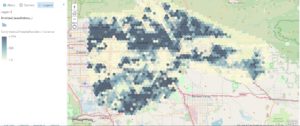
For workshops and seminars developed by one instructor, AAG will pay the instructor $1,500, and for those developed by more than one instructor, AAG will pay $1,000 per instructor. Proposals with multiple instructors must include clearly defined roles and responsibilities. AAG is also offering a $100 stipend for up to four graduate students to assist instructor(s) during interactive sessions. If selected, the instructor(s) will be able to pick a week between March and June 2021 during which they will offer the seminar or workshop.

The deadline to apply is on or before Thursday, January 14, 2021. See more details and apply here.

Get ready for the 2021 AAG Election

Election-button-1

The AAG election will be conducted online again, and voting will take place January 7-28, 2021. Each member who has an email address on record with the AAG will receive a special email with a code that will allow them to sign in to our AAG SimplyVoting website and vote. It’s important to update your email address in your AAG account to ensure you receive the email ballot. The 2021 election slate will be published soon.

Be prepared for the election.

POLICY CORNER

2021 Redistricting: How Geographers Can Get Involved

US_Capitol-2

The U.S. Census Bureau is quickly approaching their Dec. 31st deadline to report all population counts in order for states to proceed with the 2021 redistricting process. Due to complications and some irregularities revealed from the 2020 Census, however, the bureau runs a real risk of missing that deadline. These “processing anomalies” have shown some major inconsistencies that could take weeks to rectify. But once disclosed, the state population reports signify the kickoff of next year’s nationwide redistricting.

Geographers have been conducting extensive work on gerrymandering and the redistricting process for years. While these researchers demonstrate great expertise and experience, it is clear that anyone with strong geospatial understanding has something to contribute to the redistricting process. It’s a perspective that redistricting officials sorely need, but often lack. And you do not have to be a GIS expert to get involved.

If you have as little as 15 minutes, you can make an impact. The AAG has compiled the following guide on Four Ways You Can Make an Impact on Gerrymandering and Redistricting.

In the News:

  • Congress is voting to extend government funding at current FY20 levels to avert a government shutdown Friday. The extension will last only one week with the goal of finalizing FY21 appropriations before adjourning for the holiday recess. 
  • Negotiations continue for a COVID relief package that both parties can agree on. A bipartisan group of Senators is working on a compromise bill that comes in at $908 billion. If a deal can be reached, it will be considered as part of the FY21 appropriations package.
  • NSF is inviting proposals for new SBE-led initiatives on strengthening infrastructure, broadening participation in entrepreneurship, and enhancing social science capacity at minority-serving institutions.
MEMBER NEWS

Profiles of Professional Geographers

Trang_VoPham_crop2_1-225x300-1

In her position as an Assistant Professor of Epidemiology in the Epidemiology Program, Division of Public Health Sciences, at Fred Hutchinson Cancer Research Center, Trang VoPham investigates environmental risk factors for cancer using geospatial methods to understand how place or location might impact health. VoPham has seen a recent emphasis on geospatial science in jobs advertisements for cancer centers, a sign that geospatial skills can be “highly valuable and useful in careers related to epidemiology and environmental health.”

Learn more about Geography Careers on the recently updated AAG Jobs & Careers website.

December Member Updates

The latest news about AAG Members.

Guo Chen (Michigan State University) received an Outstanding Service Award from AAG-China Geography Specialty Group. This award is presented to the individuals who provided significant services to the China Geography Specialty Group or made important contributions to the advancement of China geography studies.

The China Geography Specialty Group also presented the Student Paper Award to Ronghao Jiang (Hong Kong University), and two Student Travel Awards to Samuel Kay (Ohio State University) and Jiang Chang (Michigan State University). These student awards recognize excellent student papers presented in CGSG-sponsored sessions at the AAG annual meeting, and testify to the hard work invested by students, mentors and institutions supporting them, to generate outstanding research.

RESOURCES AND OPPORTUNITIES

Free Access: 49 Articles on Black Geographies and Racial Justice

In response to the call for more open access to vital scholarship on anti-Blackness and racism, issued by the Black Geographies Specialty Group last June and supported by 37 other AAG Specialty and Affinity Groups in their own letters, AAG and Taylor & Francis are providing free access to 49 articles from our journals through December 31, 2020. AAG acknowledges that this is but one action we must take toward creating a more representative discipline that fully responds to the urgency of confronting and defeating systemic racism, within our discipline and in society at large.

See the articles.

End of Year Deadlines for Grants and Awards, Students and Professionals

awards_hi-res-300x160-1

As the calendar year comes to a close, several deadlines for grants and awards are approaching. December 31st marks the deadline for multiple student awards such as the AAG Dissertation Research Grants  or the Hess Community College Geography Scholarship. Students and professionals are invited to apply for fieldwork related awards through either an AAG Research Grant or the Anne White Fund, both also due on December 31st. Nominations are currently being solicited for a variety of books in geography awards including the Globe Book Award, the Jackson Prize, and the Meridian Book Award, all of which are due on December 31st. Members may also nominate their colleagues for the Glenda Laws Award for social justice and the Harold M. Rose Award for anti-racism research and practice as well as the AAG Wilbanks Prize for Transformational Research in Geography. For colleagues who have made contributions to geography in teaching, consider nominations to the Harm J. de Blij Award for Excellence in Undergraduate Geography Teaching or the AAG E. Willard and Ruby S. Miller Award, both also due December 31st.

See all grants and awards deadlines.

Call for Submissions for you are here

you-are-here-290x290-1

you are here: the journal of creative geography is now accepting submissions for the 2021 issue: bodies & politics. This issue will focus on the significance and political potentials of bodies and embodiment in the current political moment. Please see the full call for submissions on the you are here website. you are here is an annual publication produced by graduate students at the University of Arizona School of Geography, Development, and Environment. The journal seeks to explore geographic themes through poetry, creative writing, maps, photographs, visual art, sonic art, film, and other imaginable genres. you are here encourages submissions from geographers, historians, anthropologists, architects, scientists, writers, artists, activists and anyone else interested in exploring creative geography.

Submissions are due January 12, 2021, by the end of the day. For details of submission guidelines and process, visit the website.

December Kauffman Foundation Early-stage Researcher Professional Development Series

Kauffmann-300x110-1

The next virtual Early-Stage Research Professional Development session will take place 1 p.m. CST December 11, 2020 with mentors Jason P. Brown, a Research and Policy Officer in the Economic Research Department of the Federal Reserve Bank of Kansas City and Peter G. Klein, W. W. Caruth Endowed Chair, Professor of Entrepreneurship, and Chair of the Department of Entrepreneurship and Corporate Innovation at Baylor University Hankamer School of Business. This series is open to 15 early-stage researchers to connect with research mentors to discuss research approaches, professional development and the research career trajectory.

Register here for the December session.

IN MEMORIAM

The AAG is saddened to hear of the passing of these colleagues.

Alex Trebek, the Jeopardy! host, passed away on November 8, 2020 at the age of 80 surrounded by family and friends. The broadcaster turned game show host was endeared by millions. Trebek was a lifelong lover of geography and hosted the National Geographic Bee for 25 years from 1989 to 2013. He championed for geographic education and encouraged students to be knowledgeable on the world around them.

Jan Morris, the Welsh historian and travel writer died November 20, 2020 at the age of 94. Morris wrote extensively about history, the details of place, and her life as a transgender woman. Morris covered the first ascent of Mount Everest with Edmund Hillary in 1953 and continued to write about some of the most important moments in history. Her work reinvented travel writing and her book, Conundrum discusses transexuality and opened doors to pioneering gender geographies.

FEATURED ARTICLES

The Advancement of Location Analytics in Business Schools

By Joseph Kerski

insurance-300x126-1

A quiet geographic revolution is occurring on many university and college campuses around the world. Faculty and students in schools and colleges of business are increasingly turning to GIS tools and data in instruction and research. Given that business has always been about “location, location, location,” it makes sense that educators seeking to prepare their students for the workplace are doing so. Yet location analytics, as it is most often called in business schools, took some years to gain a firm foothold. Why is this the case, what are the implications, and how can the geography community assist with these exciting developments?

Continue reading.

GEOGRAPHERS IN THE NEWS
  • Danny Dorling, Halford Mackinder professor of human geography at Oxford University, discusses the geographies of COVID-19 in England in The Guardian
  • Stefan Gössling, a Swedish professor at the Linnaeus University School of Business and Economics produced studies on how global aviation is contributing to the climate crisis and is interviewed by The Guardian
  • Marynia Kolak, a health geographer at the University of Chicago claims social determinants are key to understanding the pandemic in The Chicago Maroon
  • Jola Ajibade, assistant professor at Portland State University, is interviewed by Yale Environment 360 about how managed retreat programs need to adapt and become equitable amongst rising seas and the increasing risks of living on the world’s coasts.
  • Ruth DeFries, an environmental geographer and professor at Columbia University is interviewed in State of the Planet about her new book on adopting strategies from the natural world to solve world problems.
EVENTS CALENDAR
    Share

Newsletter – April 2020

PRESIDENT’S COLUMN

Advocate for Geography in Austerity

By Amy Lobben

Better_Days_Ahead_IanTaylor_Unsplash-300x169-1This month I will begin a two-part column on what geography departments can do (and should not do) to advocate for their work in budget talks, which are all the more crucial during the COVID-19 pandemic. These points are largely derived from answers I received from geographers in upper administrative positions at universities.

If 2020 has taught us nothing else, it is that geography is a crucial discipline for grasping and addressing the dire issues our earth faces. Yet in a year that has demonstrated our value, some of our geography departments continue to struggle for relevancy of university campuses.

Continue Reading.

ANNUAL MEETING

AAG Annual Meeting Goes Virtual for 2021

AM2021V-1000X1000sq-290x290-1

In mid-November, AAG made the difficult but necessary decision to shift the 2021 annual meeting to a completely virtual experience. While we are encouraged by recent news of breakthrough treatment and prevention options for COVID-19, the pandemic’s current trajectory indicates that it won’t be fully resolved by April. A streamlined process is in place to help session and activity organizers bring their programming to the virtual environment, with the assistance of AAG staff. The shift to virtual does not affect any of our existing deadlines for registration, submissions, or session organizing. We want to thank you for being part of the AAG community. Your presence and support mean the world to us.

PUBLICATIONS

Journals-newsletter-100-1Read the latest issues of all of the AAG journals online:

• Annals of the American Association of Geographers
• The Professional Geographer
• GeoHumanities
• The AAG Review of Books

New issue of African Geographical Review

African-Geographical-Review-cvr-212x300-1The latest issue of the journal of the Africa Specialty Group of the AAG, the African Geographical Review, has recently been published. Volume 39, Issue 4 (December 2020) is available online for subscribers and members of the Africa Specialty Group. The latest issue contains six articles covering all sub-fields of geography and one article commentary, to enhance the standing of African regional geography, and to promote a better representation of African scholarship.

See more about the journal.

ASSOCIATION NEWS

Thank you for your support of the Bridging the Digital Divide Fund

BDD_testamony-300x169-1Our thanks to members and supporters who made gifts on Giving Tuesday, December 1st, to AAG’s Bridging the Digital Divide Fund. We received 37 donations, and hope to reach 100 by the end of the month.

Bridging the Digital Divide addresses the technology gap that affects too many students–particularly those who are enrolled at minority-serving institutions–who cannot afford personal computers, software, and internet access. The pandemic interfered with the education of many geography students at minority-serving institutions, affecting their ability to complete or even enroll in classes, and causing them to postpone their education as they were unable to connect remotely to the classroom.

Right now, AAG is working with faculty at eight Tribal Colleges and Universities, fourteen Historically Black Colleges and Universities, and one predominantly Black institution to close the technology gap. AAG has provided funds for these geography programs to purchase laptops, software, and internet connections for their students. More than 200 geography students benefited this semester, and we hope to expand the program.

The digital divide existed before COVID-19 and will not go away even as solutions to the pandemic begin to emerge. There’s still time to make a gift. Our collective action will help to leverage industry and foundation partners. No matter the size of your gift, it will make a difference.

Give Now to Bridging the Digital Divide.

Congratulations to Outstanding Graduate Student Papers from Regional Meetings

Regional_Divisions_interactive_map467-300x204-1The AAG is proud to announce the Fall 2020 student winners of the AAG Council Award for Outstanding Graduate Student Paper at a Regional Meeting. The annual award, designed to both encourage regional meeting participation and support AAG Annual Meeting attendance, is granted to one student from each division as decided by regional division board members. The winners from each region will present their work in two dedicated sessions at the 2021 AAG Annual Meeting. Congratulations to all of the students who participated!

Read more about the recipients.

Call for Proposals: AAG Learning Series on Graduate Research Methods in COVID-19

Geography-Methods-during-a-Pandemic-flipped-300x124-1AAG has issued a new call for proposals, seeking instructors and graduate assistants for its  Learning Series for Graduate Students this spring. To support graduate students in adapting in their research during COVID-19, AAG seeks instructors at all levels and in all sectors (professionals  lecturers, and faculty from early to advanced career) to develop virtual seminars or workshops.

For workshops and seminars developed by one instructor, AAG will pay the instructor $1,500, and for those developed by more than one instructor, AAG will pay $1,000 per instructor. Proposals with multiple instructors must include clearly defined roles and responsibilities. AAG is also offering a $100 stipend for up to four graduate students to assist instructor(s) during interactive sessions. If selected, the instructor(s) will be able to pick a week between March and June 2021 during which they will offer the seminar or workshop.

The deadline to apply is on or before Thursday, January 14, 2021. See more details and apply here.

Get ready for the 2021 AAG Election

Election-button-1

The AAG election will be conducted online again, and voting will take place January 7-28, 2021. Each member who has an email address on record with the AAG will receive a special email with a code that will allow them to sign in to our AAG SimplyVoting website and vote. It’s important to update your email address in your AAG account to ensure you receive the email ballot. The 2021 election slate will be published soon.

Be prepared for the election.

POLICY CORNER

2021 Redistricting: How Geographers Can Get Involved

US_Capitol-2

The U.S. Census Bureau is quickly approaching their Dec. 31st deadline to report all population counts in order for states to proceed with the 2021 redistricting process. Due to complications and some irregularities revealed from the 2020 Census, however, the bureau runs a real risk of missing that deadline. These “processing anomalies” have shown some major inconsistencies that could take weeks to rectify. But once disclosed, the state population reports signify the kickoff of next year’s nationwide redistricting.

Geographers have been conducting extensive work on gerrymandering and the redistricting process for years. While these researchers demonstrate great expertise and experience, it is clear that anyone with strong geospatial understanding has something to contribute to the redistricting process. It’s a perspective that redistricting officials sorely need, but often lack. And you do not have to be a GIS expert to get involved.

If you have as little as 15 minutes, you can make an impact. The AAG has compiled the following guide on Four Ways You Can Make an Impact on Gerrymandering and Redistricting.

In the News:

  • Congress is voting to extend government funding at current FY20 levels to avert a government shutdown Friday. The extension will last only one week with the goal of finalizing FY21 appropriations before adjourning for the holiday recess. 
  • Negotiations continue for a COVID relief package that both parties can agree on. A bipartisan group of Senators is working on a compromise bill that comes in at $908 billion. If a deal can be reached, it will be considered as part of the FY21 appropriations package.
  • NSF is inviting proposals for new SBE-led initiatives on strengthening infrastructure, broadening participation in entrepreneurship, and enhancing social science capacity at minority-serving institutions.
MEMBER NEWS

Profiles of Professional Geographers

Trang_VoPham_crop2_1-225x300-1

In her position as an Assistant Professor of Epidemiology in the Epidemiology Program, Division of Public Health Sciences, at Fred Hutchinson Cancer Research Center, Trang VoPham investigates environmental risk factors for cancer using geospatial methods to understand how place or location might impact health. VoPham has seen a recent emphasis on geospatial science in jobs advertisements for cancer centers, a sign that geospatial skills can be “highly valuable and useful in careers related to epidemiology and environmental health.”

Learn more about Geography Careers on the recently updated AAG Jobs & Careers website.

December Member Updates

The latest news about AAG Members.

Guo Chen (Michigan State University) received an Outstanding Service Award from AAG-China Geography Specialty Group. This award is presented to the individuals who provided significant services to the China Geography Specialty Group or made important contributions to the advancement of China geography studies.

The China Geography Specialty Group also presented the Student Paper Award to Ronghao Jiang (Hong Kong University), and two Student Travel Awards to Samuel Kay (Ohio State University) and Jiang Chang (Michigan State University). These student awards recognize excellent student papers presented in CGSG-sponsored sessions at the AAG annual meeting, and testify to the hard work invested by students, mentors and institutions supporting them, to generate outstanding research.

RESOURCES AND OPPORTUNITIES

Free Access: 49 Articles on Black Geographies and Racial Justice

In response to the call for more open access to vital scholarship on anti-Blackness and racism, issued by the Black Geographies Specialty Group last June and supported by 37 other AAG Specialty and Affinity Groups in their own letters, AAG and Taylor & Francis are providing free access to 49 articles from our journals through December 31, 2020. AAG acknowledges that this is but one action we must take toward creating a more representative discipline that fully responds to the urgency of confronting and defeating systemic racism, within our discipline and in society at large.

See the articles.

End of Year Deadlines for Grants and Awards, Students and Professionals

awards_hi-res-300x160-1

As the calendar year comes to a close, several deadlines for grants and awards are approaching. December 31st marks the deadline for multiple student awards such as the AAG Dissertation Research Grants  or the Hess Community College Geography Scholarship. Students and professionals are invited to apply for fieldwork related awards through either an AAG Research Grant or the Anne White Fund, both also due on December 31st. Nominations are currently being solicited for a variety of books in geography awards including the Globe Book Award, the Jackson Prize, and the Meridian Book Award, all of which are due on December 31st. Members may also nominate their colleagues for the Glenda Laws Award for social justice and the Harold M. Rose Award for anti-racism research and practice as well as the AAG Wilbanks Prize for Transformational Research in Geography. For colleagues who have made contributions to geography in teaching, consider nominations to the Harm J. de Blij Award for Excellence in Undergraduate Geography Teaching or the AAG E. Willard and Ruby S. Miller Award, both also due December 31st.

See all grants and awards deadlines.

Call for Submissions for you are here

you-are-here-290x290-1

you are here: the journal of creative geography is now accepting submissions for the 2021 issue: bodies & politics. This issue will focus on the significance and political potentials of bodies and embodiment in the current political moment. Please see the full call for submissions on the you are here website. you are here is an annual publication produced by graduate students at the University of Arizona School of Geography, Development, and Environment. The journal seeks to explore geographic themes through poetry, creative writing, maps, photographs, visual art, sonic art, film, and other imaginable genres. you are here encourages submissions from geographers, historians, anthropologists, architects, scientists, writers, artists, activists and anyone else interested in exploring creative geography.

Submissions are due January 12, 2021, by the end of the day. For details of submission guidelines and process, visit the website.

December Kauffman Foundation Early-stage Researcher Professional Development Series

Kauffmann-300x110-1

The next virtual Early-Stage Research Professional Development session will take place 1 p.m. CST December 11, 2020 with mentors Jason P. Brown, a Research and Policy Officer in the Economic Research Department of the Federal Reserve Bank of Kansas City and Peter G. Klein, W. W. Caruth Endowed Chair, Professor of Entrepreneurship, and Chair of the Department of Entrepreneurship and Corporate Innovation at Baylor University Hankamer School of Business. This series is open to 15 early-stage researchers to connect with research mentors to discuss research approaches, professional development and the research career trajectory.
Register here for the December session.

IN MEMORIAM

The AAG is saddened to hear of the passing of these colleagues.

Alex Trebek, the Jeopardy! host, passed away on November 8, 2020 at the age of 80 surrounded by family and friends. The broadcaster turned game show host was endeared by millions. Trebek was a lifelong lover of geography and hosted the National Geographic Bee for 25 years from 1989 to 2013. He championed for geographic education and encouraged students to be knowledgeable on the world around them.

Jan Morris, the Welsh historian and travel writer died November 20, 2020 at the age of 94. Morris wrote extensively about history, the details of place, and her life as a transgender woman. Morris covered the first ascent of Mount Everest with Edmund Hillary in 1953 and continued to write about some of the most important moments in history. Her work reinvented travel writing and her book, Conundrum discusses transexuality and opened doors to pioneering gender geographies.

FEATURED ARTICLES

The Advancement of Location Analytics in Business Schools

By Joseph Kerski

insurance-300x126-1

A quiet geographic revolution is occurring on many university and college campuses around the world. Faculty and students in schools and colleges of business are increasingly turning to GIS tools and data in instruction and research. Given that business has always been about “location, location, location,” it makes sense that educators seeking to prepare their students for the workplace are doing so. Yet location analytics, as it is most often called in business schools, took some years to gain a firm foothold. Why is this the case, what are the implications, and how can the geography community assist with these exciting developments?

Continue reading.

GEOGRAPHERS IN THE NEWS
  • Danny Dorling, Halford Mackinder professor of human geography at Oxford University, discusses the geographies of COVID-19 in England in The Guardian
  • Stefan Gössling, a Swedish professor at the Linnaeus University School of Business and Economics produced studies on how global aviation is contributing to the climate crisis and is interviewed by The Guardian
  • Marynia Kolak, a health geographer at the University of Chicago claims social determinants are key to understanding the pandemic in The Chicago Maroon
  • Jola Ajibade, assistant professor at Portland State University, is interviewed by Yale Environment 360 about how managed retreat programs need to adapt and become equitable amongst rising seas and the increasing risks of living on the world’s coasts.
  • Ruth DeFries, an environmental geographer and professor at Columbia University is interviewed in State of the Planet about her new book on adopting strategies from the natural world to solve world problems.
EVENTS CALENDAR
    Share